
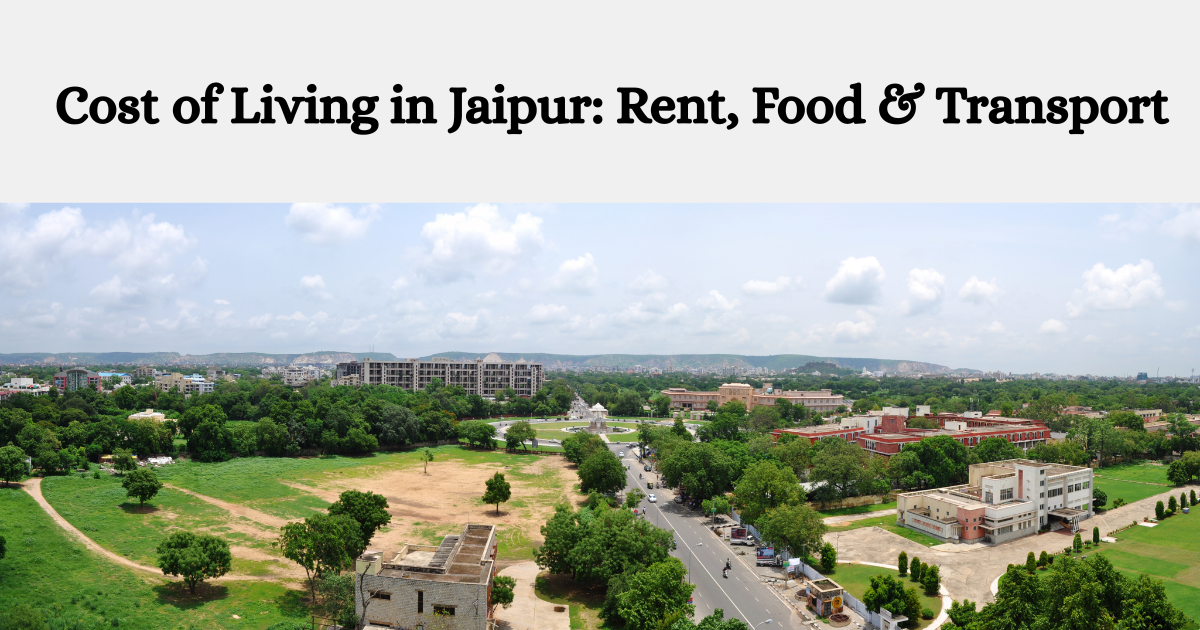
Jaipur is one of the most affordable major cities in India — and that is not just a claim made by travel bloggers. According to global cost of living databases updated in 2025, Jaipur ranks among the top 3% of the least expensive cities in the world and is the most affordable city in Rajasthan. Whether you are a student thinking of moving here for college, a professional considering a job relocation, a digital nomad looking for an affordable base in India, or simply a traveler curious about what day-to-day life actually costs in the Pink City — this guide has the numbers you need.
This article breaks down the real cost of living in Jaipur in 2025-2026 across every major expense category: rent, food, transport, utilities, groceries, entertainment, healthcare, and more. We have also included neighbourhood-by-neighbourhood rent comparisons, monthly budget estimates for different types of residents, and practical money-saving tips from people who actually live here.
Table of Contents
- Overview: How Affordable Is Jaipur?
- Rent in Jaipur — Area-Wise Breakdown
- Food Costs in Jaipur
- Daily Transport Costs
- Groceries and Household Shopping
- Utilities, Internet & Mobile
- Healthcare Costs
- Education Costs
- Entertainment and Lifestyle
- Complete Monthly Budget Estimates
- Jaipur vs Other Indian Cities — Cost Comparison
- Money-Saving Tips for Living in Jaipur
- Best Areas to Live in Jaipur for Different Budgets
Overview: How Affordable Is Jaipur?
Jaipur offers a standard of living that punches well above its price tag. The city has all the infrastructure of a major metropolitan area — a functioning metro, international airport, large hospitals, quality schools and colleges, malls, restaurants, and a thriving cultural scene — at a fraction of the cost you would pay in cities like Delhi, Mumbai, Bengaluru, or Pune.
According to data from Numbeo updated in April 2026, the estimated monthly costs for a single person in Jaipur are approximately ₹28,200 excluding rent. For a family of four, the equivalent figure excluding rent is approximately ₹95,000. These figures represent a middle-of-the-road lifestyle — neither the most frugal nor the most lavish. In practice, a single professional living comfortably in Jaipur can do so for ₹20,000 to ₹35,000 per month all-in, while a budget-conscious student can get by for ₹10,000 to ₹18,000 per month.
What makes Jaipur particularly attractive for long-term residents is the combination of affordability and quality of life. The city has relatively low pollution compared to Delhi, a slower pace of life, excellent local food at street-level prices, reasonable property costs, and a rich cultural environment that makes daily life genuinely enjoyable. It is not a compromise city — it is a genuinely good city that happens to also be affordable.
Rent in Jaipur — Area-Wise Breakdown
Rent is typically the single largest monthly expense for anyone living in Jaipur, and the range is significant — from ₹4,000 per month for a basic 1BHK in a budget neighbourhood to ₹50,000 or more for a large, fully furnished apartment in a premium locality. Here is a detailed breakdown by apartment type and area.
1 BHK Apartments
A 1 BHK (one bedroom, hall, kitchen) apartment is the most common choice for students, single professionals, and young couples just starting out. In Jaipur’s more affordable areas — such as Jhotwara, Ajmer Road, Sirsi Road, Gandhi Path, and Pratap Nagar — you can find basic unfurnished 1 BHK flats starting from ₹4,000 to ₹7,000 per month. In mid-range localities like Mansarovar, Vidhyadhar Nagar, and Shyam Nagar, 1 BHK rents typically range from ₹7,000 to ₹12,000 per month. In premium areas like Vaishali Nagar, Malviya Nagar, and Civil Lines, a 1 BHK will cost between ₹10,000 and ₹18,000 per month. In the most sought-after areas like C-Scheme and Bani Park, well-furnished 1 BHK flats can command ₹15,000 to ₹25,000 per month.
2 BHK Apartments
A 2 BHK (two bedroom) apartment is the most popular choice for couples, small families, and groups of flatmates sharing costs. In budget areas, 2 BHK unfurnished flats are available from ₹8,000 to ₹14,000 per month. In mid-range localities, expect to pay ₹12,000 to ₹20,000 for a decent semi-furnished 2 BHK. In premium areas like Vaishali Nagar and Malviya Nagar, 2 BHK rents typically fall between ₹15,000 and ₹30,000. Fully furnished 2 BHK apartments in Bani Park and C-Scheme range from ₹25,000 to ₹40,000 per month.
3 BHK Apartments
For families needing more space, 3 BHK apartments in Jaipur are available across a wide range. In mid-range areas, semi-furnished 3 BHK flats are available from ₹18,000 to ₹28,000 per month. In upmarket localities like Bani Park, Civil Lines, and Vaishali Nagar Extension, 3 BHK flats range from ₹30,000 to ₹55,000 per month for fully furnished options. Even at the top end, these prices are significantly lower than comparable accommodation in Delhi or Mumbai.
PG Accommodation and Shared Rooms
Paying Guest (PG) accommodation is the most affordable rental option and is widely available in Jaipur, particularly around the city’s many colleges and universities. PG facilities typically include a furnished room, meals, and basic amenities. Shared PG accommodation starts from as low as ₹3,000 to ₹5,000 per month and single-occupancy PG rooms with meals included are available from ₹5,000 to ₹10,000 per month. This is by far the most economical option for students and those on a very tight budget.
Security Deposit and Other Costs
Most landlords in Jaipur require a security deposit of 2 to 3 months’ rent upfront, which is returned at the end of the tenancy subject to deductions for damage. Broker fees, when applicable, are typically one month’s rent. Some landlords in Jaipur charge a separate maintenance fee of ₹500 to ₹2,000 per month for common area maintenance, security, and building services.
Food Costs in Jaipur
Food is where Jaipur truly shines in terms of affordability. The city offers an extraordinary range of eating options — from ₹30 street food snacks to fine dining meals — and even eating out regularly does not have to be expensive if you know where to go.
Street Food and Local Dhabas
Street food in Jaipur is both outstanding and extremely affordable. A typical street food meal — say two Pyaaz Kachoris with chai for breakfast, or a plate of chaat and a glass of lassi in the evening — will cost between ₹30 and ₹100 per person. A full Rajasthani thali at a local dhaba, which typically includes dal, sabzi, roti, rice, papad, and dessert, costs between ₹80 and ₹150 and is easily enough for one person. A cup of masala chai at a street stall costs ₹10 to ₹20. If you are comfortable eating at street stalls and local dhabas — which most residents of Jaipur are — you can eat three meals a day for ₹150 to ₹300 per person per day, or roughly ₹4,500 to ₹9,000 per month on food.
Mid-Range Restaurants
Jaipur has hundreds of decent mid-range restaurants where you can eat a full meal for ₹200 to ₹500 per person. These include everything from Rajasthani cuisine restaurants to Chinese, South Indian, and North Indian places. A meal for two at a mid-range restaurant with drinks typically costs ₹400 to ₹800. If you eat out at mid-range restaurants for most meals, expect to spend ₹8,000 to ₹15,000 per month on food as a single person.
Cafes and Modern Eateries
Jaipur has a growing cafe culture, particularly in areas like C-Scheme, Bani Park, and Malviya Nagar, where stylish cafes serve good coffee, sandwiches, and international food. A coffee at a decent cafe costs ₹80 to ₹200. A meal at a trendy cafe or modern restaurant in these areas typically runs ₹300 to ₹700 per person. While not an everyday option on a tight budget, these places are affordable enough for occasional visits.
Home Cooking
For those who cook at home, Jaipur’s local vegetable markets and kirana stores offer excellent value. Fresh vegetables, dal, rice, atta, and other staples are all priced very affordably. A single person who cooks most meals at home can manage their food budget for ₹3,000 to ₹6,000 per month on groceries, producing a much lower overall food spend than eating out regularly.
Daily Transport Costs
Transport in Jaipur is genuinely cheap by any standard. Most residents who use public transport and autos for their daily commute spend between ₹1,000 and ₹3,000 per month on transport, depending on the distances involved and the modes they use.
Public Transport (Metro and Bus)
The Jaipur Metro charges ₹10 to ₹30 per journey. A daily metro commuter who takes two trips per day (to and from work) would spend approximately ₹600 to ₹1,800 per month on metro fares alone. JCTSL city buses charge ₹5 to ₹25 per trip, making them the cheapest public transport option. A person relying primarily on city buses for their daily commute could spend as little as ₹300 to ₹800 per month on transport.
Auto-Rickshaws
The revised 2025 auto fare in Jaipur is ₹17.14 per km with a minimum of ₹26. Most short city trips cost between ₹40 and ₹150. Someone taking two auto trips per day — say one to work and one back — would spend approximately ₹2,400 to ₹9,000 per month on autos depending on distance. Using the metro for the main commute and autos only for the last mile is the most cost-effective combination for most city residents.
Ola and Uber
App-based cabs are more expensive than autos and buses but remain affordable by major city standards. A short city ride on Ola or Uber costs ₹100 to ₹200. Using cabs for a daily commute would cost significantly more than public transport but is still notably cheaper than in Mumbai, Delhi, or Bengaluru. Most Jaipur residents use app cabs selectively rather than as their primary daily transport.
Personal Two-Wheeler
Owning a scooter or motorcycle is a very popular choice in Jaipur for daily commuting and dramatically reduces transport costs for those who travel regularly. Monthly fuel costs for a typical scooter commuter covering 40 to 60 km per day are approximately ₹1,500 to ₹2,500 per month. Maintenance costs are low, insurance is affordable, and the freedom a two-wheeler offers in Jaipur’s traffic makes it a very practical investment for long-term residents.
Groceries and Household Shopping
Groceries in Jaipur are notably affordable, especially when bought from local markets and kirana stores rather than supermarkets. Here is a rough guide to current grocery prices in Jaipur for commonly purchased items:
- Onions: ₹25–₹40 per kg
- Tomatoes: ₹20–₹50 per kg (varies seasonally)
- Potatoes: ₹20–₹35 per kg
- Moong Dal: ₹90–₹120 per kg
- Wheat Flour (Atta, 10 kg): ₹280–₹350
- Rice (1 kg): ₹40–₹80 depending on variety
- Milk (1 litre, Saras/Amul): ₹54–₹60
- Eggs (12): ₹80–₹100
- Cooking Oil (1 litre): ₹120–₹180
- LPG Cylinder (14.2 kg): ₹800–₹900 approximately
A single person cooking at home can manage their monthly grocery spend in the range of ₹3,000 to ₹6,000 depending on dietary preferences and whether they shop at local markets or supermarkets. A family of four typically spends between ₹8,000 and ₹15,000 per month on groceries.
Utilities, Internet and Mobile
Utility costs in Jaipur are moderate and very manageable. Here is what you can expect to pay each month.
Electricity
Electricity in Jaipur is supplied by the Jaipur Vidyut Vitran Nigam (JVVNL). Monthly electricity bills for a 1 BHK apartment with normal usage (fans, lights, refrigerator, and moderate AC usage in summer) typically run between ₹800 and ₹2,000 per month. In the summer months of May and June when AC usage spikes significantly, electricity bills can reach ₹3,000 to ₹5,000 for heavy AC users. Many landlords include electricity in the rent for older buildings, so always clarify this before signing a rental agreement.
Water
Municipal water supply in Jaipur is relatively affordable. Most residential areas receive piped water and the cost is included in municipal taxes or charged at very low rates. Most apartments also have water storage tanks to manage the intermittent supply. Many residents purchase RO-filtered water from local vendors for drinking at approximately ₹30 to ₹50 per 20-litre can.
Broadband Internet
Internet connectivity in Jaipur is good and competitively priced. Major providers including Airtel, JioFiber, and BSNL offer broadband plans starting from ₹400 to ₹700 per month for speeds of 30 to 100 Mbps. Faster plans with higher data limits are available from ₹800 to ₹1,500 per month. For most work-from-home professionals and students, a ₹500 to ₹700 broadband plan is entirely adequate.
Mobile Phone
Mobile phone costs in India are among the lowest in the world and Jaipur is no exception. A Jio or Airtel prepaid plan offering unlimited calling and 1.5 GB to 2 GB of daily 4G data costs between ₹200 and ₹350 per month. Postpaid plans with similar benefits start from around ₹400 per month. Most residents in Jaipur spend between ₹200 and ₹500 per month on their mobile plans.
Healthcare Costs in Jaipur
Jaipur has a well-developed healthcare infrastructure with both government hospitals and a large number of private hospitals and clinics. Healthcare costs are significantly lower than in Delhi or Mumbai for comparable quality of care.
A general consultation with a private doctor costs approximately ₹300 to ₹600. A specialist consultation at a good private hospital typically costs ₹500 to ₹1,500. Common diagnostic tests like blood work, X-rays, and ultrasounds are available at private labs for ₹200 to ₹2,000 depending on the test. Major hospitals in Jaipur include SMS Hospital (government, very affordable), Fortis Escorts Hospital, Narayana Multispeciality Hospital, Eternal Hospital, and Manipal Hospital.
Health insurance is strongly recommended for anyone living in Jaipur long-term. A basic individual health insurance plan with ₹5 lakh sum assured costs approximately ₹5,000 to ₹10,000 per year for a healthy adult under 35, which works out to less than ₹1,000 per month — excellent value for the peace of mind it provides.
Education Costs in Jaipur
Jaipur is one of India’s most significant educational cities and offers a wide range of schooling and higher education options at all price points. Government schools charge very nominal fees. Private English-medium schools charge between ₹2,000 and ₹8,000 per month in tuition fees depending on the institution and level. Premium international schools charge considerably more — ₹10,000 to ₹25,000 per month — but these are at the top end of the market.
For higher education, Jaipur has several universities and colleges including the University of Rajasthan, Jaipur National University, BITS Pilani (Jaipur campus), Manipal University Jaipur, and many others. Annual tuition fees at reputable private colleges and universities typically range from ₹60,000 to ₹2,50,000 per year depending on the course and institution, which remains very affordable compared to equivalent institutions in Delhi, Mumbai, or Bengaluru.
Entertainment and Lifestyle in Jaipur
Entertainment in Jaipur is very affordably priced. A movie ticket at a multiplex (PVR or Inox) costs ₹150 to ₹400 depending on the screen type and timing. A membership at a decent gym costs approximately ₹600 to ₹1,500 per month. A visit to a major monument like Amber Fort or City Palace costs ₹100 to ₹200 for Indian nationals. Entry to the major malls like World Trade Park and Pink Square is free, with spending on food and shopping being optional.
Jaipur has a very active cultural scene with numerous free and low-cost events — music performances at heritage venues, exhibitions, cultural programmes at Ravindra Manch, and annual events like the Jaipur Literature Festival which is entirely free to attend. For those who enjoy an active social life, Jaipur’s growing restaurant and cafe scene offers plenty of options, but it is entirely possible to have a rich and enjoyable social life in Jaipur without spending heavily.
Complete Monthly Budget Estimates for Jaipur
Here is a realistic breakdown of monthly budgets for different types of residents in Jaipur based on current 2025-2026 prices.
Student Budget (Shared PG or Hostel)
- PG accommodation (shared, meals included): ₹5,000 – ₹8,000
- Food (outside meals, snacks): ₹1,500 – ₹3,000
- Transport (bus/metro/auto): ₹500 – ₹1,000
- Mobile and internet: ₹300 – ₹500
- Stationery, books, miscellaneous: ₹500 – ₹1,500
- Entertainment and personal: ₹500 – ₹1,500
- Total: ₹8,300 – ₹15,500 per month
Single Professional (1 BHK, Mid-Range Area)
- Rent (1 BHK, Mansarovar/Vidhyadhar Nagar): ₹8,000 – ₹12,000
- Food (mix of cooking and eating out): ₹4,000 – ₹7,000
- Transport (metro + auto/scooter): ₹1,000 – ₹2,500
- Electricity and water: ₹800 – ₹2,000
- Broadband internet: ₹500 – ₹700
- Mobile: ₹200 – ₹400
- Groceries: ₹3,000 – ₹5,000
- Entertainment and personal: ₹1,000 – ₹3,000
- Miscellaneous: ₹500 – ₹1,000
- Total: ₹19,000 – ₹33,600 per month
Couple (2 BHK, Mid-Range Area)
- Rent (2 BHK, Vaishali Nagar/Malviya Nagar): ₹14,000 – ₹22,000
- Food (cooking + occasional dining out): ₹7,000 – ₹12,000
- Transport (two-wheeler + occasional cab): ₹2,000 – ₹4,000
- Electricity and utilities: ₹1,200 – ₹3,000
- Internet and mobile (two phones): ₹800 – ₹1,400
- Groceries and household items: ₹5,000 – ₹8,000
- Entertainment and eating out: ₹2,000 – ₹5,000
- Miscellaneous: ₹1,000 – ₹2,000
- Total: ₹33,000 – ₹57,400 per month
Family of Four (3 BHK, Good Locality)
- Rent (3 BHK, Bani Park/Civil Lines): ₹20,000 – ₹35,000
- Food and groceries: ₹12,000 – ₹20,000
- School fees (2 children, private school): ₹6,000 – ₹16,000
- Transport (car/scooter + school transport): ₹4,000 – ₹8,000
- Electricity and utilities: ₹2,000 – ₹5,000
- Internet, mobile (family plan): ₹1,000 – ₹2,000
- Healthcare and insurance: ₹1,500 – ₹3,000
- Entertainment and outings: ₹2,000 – ₹5,000
- Miscellaneous: ₹2,000 – ₹4,000
- Total: ₹50,500 – ₹98,000 per month
Jaipur vs Other Indian Cities — Cost Comparison
One of the most compelling reasons to consider Jaipur for long-term residence is how dramatically more affordable it is compared to India’s other major cities. Here is a general comparison of average monthly costs for a single professional (excluding rent) across major cities based on 2025 data:
- Mumbai: ₹45,000 – ₹75,000 per month
- Delhi/NCR: ₹35,000 – ₹60,000 per month
- Bengaluru: ₹35,000 – ₹65,000 per month
- Pune: ₹30,000 – ₹50,000 per month
- Hyderabad: ₹28,000 – ₹48,000 per month
- Jaipur: ₹19,000 – ₹34,000 per month
Even compared to Hyderabad — another city known for relatively affordable living — Jaipur is meaningfully cheaper. Compared to Mumbai or Delhi, the savings are dramatic. For someone earning a decent income who works remotely or has been offered equivalent salaries in different cities, choosing Jaipur means either significantly better savings or significantly better quality of life for the same money.
Money-Saving Tips for Living in Jaipur
Even in an already affordable city, a little smart planning goes a long way. Here are practical tips for keeping your costs low in Jaipur.
Shop at Local Markets, Not Supermarkets
Vegetables, fruits, dairy, and staples are significantly cheaper at local sabzi mandis and neighbourhood kirana stores than at supermarket chains like Big Bazaar or D-Mart. The quality is often better too — produce is fresher and more local. Identifying the nearest local market to your residence will save you ₹1,000 to ₹2,000 per month on groceries alone.
Use Public Transport for Your Main Commute
Combining the metro for the main leg of your commute with an e-rickshaw or bus for the first and last mile is the cheapest and often fastest way to get around central Jaipur. Reserving Ola and Uber for evenings, weekends, and trips to areas not served by the metro will keep your transport costs very manageable.
Choose Accommodation Wisely by Location
Living in areas like Mansarovar, Vidhyadhar Nagar, or Shyam Nagar rather than C-Scheme or Bani Park can cut your rent by 40 to 60 percent for equivalent space. If your workplace is not in the old city, there is no reason to pay old city or prime area rents — the metro and good bus connectivity make most of the city accessible from affordable residential areas.
Negotiate Your Rent
Unlike in Mumbai or Bengaluru where rental markets are extremely competitive, Jaipur’s rental market is generally more negotiable. Especially for longer-term leases of 11 months or more, landlords are often willing to reduce the rent by ₹500 to ₹2,000 per month in exchange for timely payment and a longer commitment. Always negotiate before signing.
Cook at Home More Often
Jaipur’s street food is extraordinarily good and affordable, but even frequent street food eating adds up over a month. Cooking at home using ingredients from local markets produces the lowest possible food spend and is healthier. A combination of home cooking for most meals and street food or dhaba meals for the occasional treat is the most cost-effective food strategy for residents on a budget.
Best Areas to Live in Jaipur for Different Budgets
Choosing the right area to live in is one of the most important decisions for anyone relocating to Jaipur. Here is a quick guide to the best neighbourhoods by budget and lifestyle preference.
Budget-Friendly Areas (Rent under ₹10,000 for 1 BHK)
Jhotwara, Ajmer Road, Sirsi Road, Gandhi Path, Pratap Nagar, and Vidhyadhar Nagar are the most affordable residential areas in Jaipur. These are well-established residential neighbourhoods with good connectivity, local markets, schools, and basic amenities — just without the premium pricing of central or upmarket areas. Ideal for students, budget-conscious professionals, and families looking to maximize their savings.
Mid-Range Areas (Rent ₹10,000 – ₹22,000 for 1-2 BHK)
Mansarovar, Malviya Nagar, Shyam Nagar, Jagatpura, and Durgapura offer excellent value in the mid-range bracket. These areas have good connectivity — Mansarovar is directly on the metro line — decent infrastructure, good schools and hospitals nearby, and a comfortable urban environment. Ideal for working professionals and mid-income families.
Premium Areas (Rent ₹20,000+ for 2-3 BHK)
Vaishali Nagar, Bani Park, Civil Lines, C-Scheme, and Tonk Road (near Durgapura) are Jaipur’s most desirable residential areas for those who want the best in terms of infrastructure, greenery, safety, and social environment. These areas also have the best selection of cafes, restaurants, schools, and medical facilities. Ideal for expats, senior professionals, and families with higher incomes.
Final Thoughts
Jaipur is one of the genuinely great cities in India for quality of life relative to cost of living. It offers big-city infrastructure, cultural richness, good connectivity, and excellent food — at prices that make the same lifestyle two to three times more expensive in Mumbai or Bengaluru. Whether you are a student, a working professional, a family, or a digital nomad looking for an affordable Indian base, Jaipur deserves serious consideration.
The key to living well in Jaipur on a budget is straightforward: live in a well-connected mid-range neighbourhood, use public transport for your daily commute, shop at local markets, and take full advantage of the city’s extraordinary street food culture. Do those things and you will find that Jaipur not only fits your budget — it exceeds your expectations.