
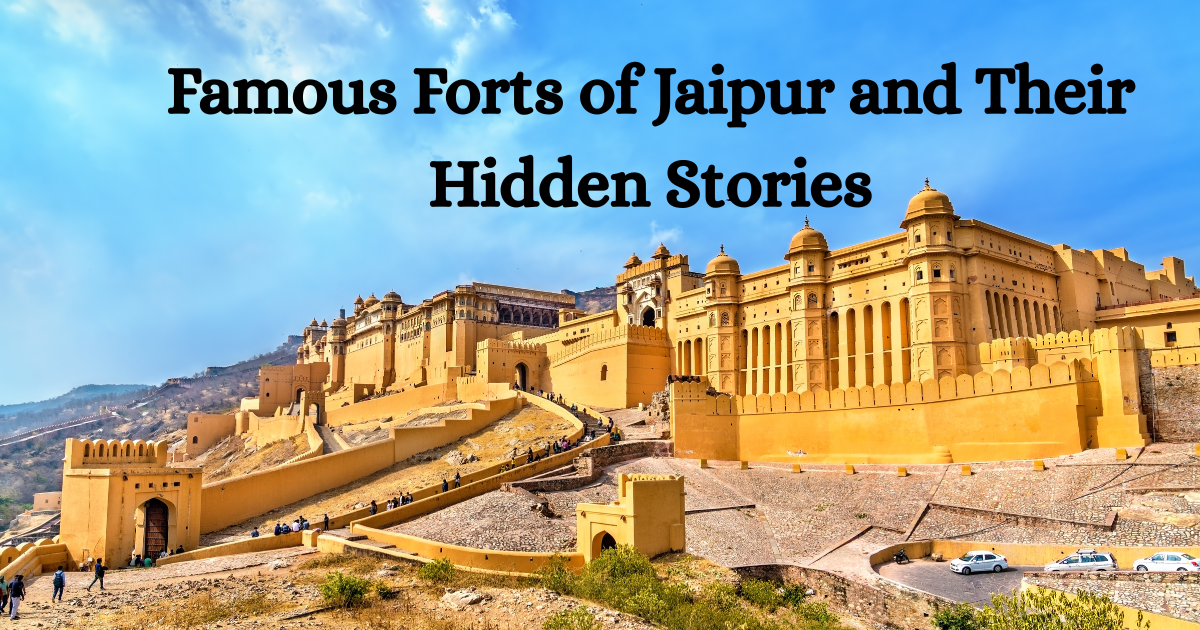
Jaipur sits within a natural bowl formed by the Aravalli Hills, and rising from those ancient rocky ridges are three of the most magnificent and historically significant forts in all of India. Amber Fort, Jaigarh Fort, and Nahargarh Fort together form a triangular ring of stone and history that protected the Pink City for centuries — each with its own distinct character, its own architectural personality, and its own remarkable collection of stories that most visitors never get to hear.
These are not simply old buildings with impressive walls. They are layered archives of ambition, ingenuity, royal intrigue, ghost legends, lost treasure hunts, and military secrets — some of which were only fully revealed to the public decades after Indian independence. This guide takes you deep into the history and hidden stories of Jaipur’s famous forts, covering everything you need to know before you visit and revealing the extraordinary tales that the standard tourist brochures almost always leave out.
Table of Contents
- The Fort Triangle of Jaipur — Understanding the Defence System
- Amber Fort — The Palace That Became a Legend
- Hidden Stories of Amber Fort
- Jaigarh Fort — The Fort of Victory and Its Secrets
- The Jaivana Cannon — The World’s Largest Cannon on Wheels
- The Lost Treasure of Jaigarh — India’s Most Dramatic Treasure Hunt
- Nahargarh Fort — The Abode of Tigers and Ghosts
- The Ghost of Nahar Singh Bhomia
- The Palace of Equal Queens — Madhavendra Bhawan
- The Secret Underground Tunnel Connecting the Forts
- Jaipur’s Forts on the Silver Screen
- Visitor Information — Entry Fees, Timings & Tips
The Fort Triangle of Jaipur — Understanding the Defence System
To truly appreciate the forts of Jaipur, you first need to understand the strategic logic that placed them where they are. The three main forts — Amber, Jaigarh, and Nahargarh — were not built independently as separate vanity projects. They were conceived and developed as a single, integrated defence system designed to make Jaipur and its predecessor capital Amber virtually impregnable from any direction of attack.
Amber Fort sits at the base of the Aravalli ridge, overlooking the Maota Lake and controlling the main road access to the capital from the north. Jaigarh Fort sits directly above Amber on the highest ridge of the hill, providing a commanding position from which artillery could dominate the entire surrounding landscape. Nahargarh Fort guards the western ridge of the Aravalli Hills, overlooking the plains and the city of Jaipur from the opposite direction. Together, these three forts formed a strong defence ring for the city that made any sustained military assault extraordinarily difficult and costly.
The three forts are connected by a continuous defensive wall that runs along the ridge of the Aravalli Hills — you can still see sections of this wall today as you drive between Amber and Nahargarh. At certain points the forts are also connected by underground passages, the most famous of which links Amber directly to Jaigarh through a secret subterranean route that allowed troops and royalty to move between the two forts without being exposed to enemy fire. This remarkable degree of integration makes the Jaipur fort system one of the most sophisticated examples of medieval military planning in India.
Amber Fort — The Palace That Became a Legend
Amber Fort — also written as Amer Fort — is the most visited and most celebrated of all Jaipur’s forts, and with good reason. It is a UNESCO Heritage Listed site as one of the Six Hill Forts of Rajasthan which form one UNESCO listing. Located approximately 11 kilometres from the city centre, the fort is located atop a hill overlooking Maota Lake. Its scale, its architectural beauty, its dramatic hilltop setting, and the extraordinary richness of its interior spaces make it one of the supreme achievements of Rajput-Mughal architecture anywhere in the world.
The history of Amber Fort stretches back much further than most people realize. Raja Kakil Dev captured the Amber region from the Mina tribes and began construction of Jaigarh Fort around the middle of the eleventh century. The site itself has therefore been fortified for nearly a thousand years, though the magnificent palace complex that visitors see today was built primarily during the 16th and 17th centuries. Constructed in the 1590s, its red sandstone facade contrasts starkly against the deep blue sky. Initially a modest fort, it became the goliath that it is today thanks to ambitious plans by Mirza Raja Jai Singh I, who ruled over the Amber Kingdom. King Raja Jai Singh expanded the fort and ordered for it to be draped in marble.
The approach to Amber Fort is dramatic in itself — a long ramp winds up from the base of the hill past a series of gateways, each more imposing than the last. The main entrance, the Suraj Pol or Sun Gate, opens into the first of four main courtyards, and from there a progression of increasingly beautiful and intimate spaces unfolds. The fort is divided into four main sections: the public spaces of the Diwan-i-Aam (Hall of Public Audience), the ceremonial Ganesh Pol gateway with its extraordinary painted facade, the private royal apartments of the Jai Mandir and Sukh Niwas, and the zenana or women’s quarters.
The architectural philosophy of Amber Fort is one of beautiful contrasts — the military severity of its outer walls and battlements giving way to a world of extraordinary delicacy and refinement within. The Ganesh Pol gateway is covered in spectacular painted murals and pietra dura inlay work of Mughal sophistication. The Jai Mandir hall has walls inlaid with thousands of tiny mirror pieces and carved marble screens of breathtaking fineness. The hall’s walls and ceiling were covered with images made of glass. When candles were lit, the space filled with thousands of stars. This is the famous Sheesh Mahal — the Hall of Mirrors — and the reason given for its creation is one of Amber’s most touching hidden stories.
Hidden Stories of Amber Fort
The Sheesh Mahal — Built So a Queen Could See the Stars
The official explanation for the Sheesh Mahal’s extraordinary mirror-inlaid ceiling is purely architectural — the technique of shisha mirror inlay was fashionable in Mughal court architecture and demonstrated the wealth and sophistication of the patron. But the story told by local guides and passed down through oral tradition is far more romantic and human. At some point in the fort’s history, the resident queen couldn’t sleep outdoors but wished to see the stars. So, the hall’s walls and ceiling were covered with images made of glass. When candles were lit, the space filled with thousands of stars. Whether historically accurate or not, this story captures something essential about the sensibility that built Amber Fort — the belief that beauty and ingenuity could solve even the most intimate human longings.
The Hidden Garden — Mughal Geometry in a Rajput Fort
Within the third courtyard of Amber Fort lies a geometric garden of Mughal design that most casual visitors rush through without fully appreciating. This garden is an example of Islamic design. It features a centrally-positioned star-shaped pool and fountain. Four paths connect the garden to different sections of the fort. Different plants and flowers are grown in each of the geometric sections. This garden is a physical embodiment of the Kachwaha-Mughal political alliance — a Mughal garden planted at the heart of a Rajput fortress, a statement of cultural accommodation and mutual respect that shaped the entire history of the region.
The Jai Ban Connection — Fort Built for a Royal in Hiding
The zenana or women’s quarter of Amber Fort is a remarkably complex structure — a labyrinthine series of interconnected apartments, corridors, and small courtyards designed to house not just the Maharaja’s wives and concubines but their attendants, guards, and support staff. The design is intentionally disorienting from the outside, making it difficult for any outsider to navigate without a guide. Within the zenana, each apartment was separated enough to give its occupant a degree of privacy and autonomy while remaining under the watchful eye of the central administration of the household. The ingenuity of its planning — providing privacy, security, and administrative control simultaneously — is one of Amber Fort’s least-celebrated architectural achievements.
Jaigarh Fort — The Fort of Victory and Its Secrets
If Amber Fort is the beautiful face of the Kachwaha kingdom, then Jaigarh Fort is its iron fist. High above the majestic Amber Fort and the serene Maota Lake stands Jaigarh Fort, one of Rajasthan’s most powerful and strategically important forts. Known as the Fort of Victory, this hilltop stronghold wasn’t designed for grandeur but for dominance, defense, and dignity.
Perched atop a raised mass of land known as the Cheelka Teela, or the Hill of Eagles, the Jaigarh Fort stands as a testament to the military prowess and architectural brilliance of the Rajput rulers. Built in 1726 by Maharaja Sawai Jai Singh II, the visionary founder of Jaipur, Jaigarh Fort served as the military base for the Amber kingdom. The fort’s red sandstone walls stretch across 6 kilometres, enclosing royal treasures, war equipment, and secure routes — built to withstand any siege or invasion.
Different to Amber Fort, which is heavily influenced by Mughal architecture, Jaigarh Fort shows signs throughout of a Persian style. There are Indian flourishes inside in the form of Ram Haribar and Kal Bhairav, its serene temples which are unmistakably Indian in appearance. The contrast between the ornate Mughal-influenced Amber below and the stark, functional military design of Jaigarh above is striking and intentional — one fort was designed to impress, the other was designed to protect.
Jaigarh was far more than just a defensive wall. During the Mughal era, the fort’s importance only grew as it became the primary cannon foundry for the dynasty, with its forges and workshops churning out the weaponry that would shape the course of history. The fort contained its own weapons factory, water storage tanks of extraordinary capacity, residential quarters for the garrison, and a remarkably sophisticated water harvesting system. The water harvesting system, complete with massive underground tanks, showcases advanced planning for prolonged battles. The largest tank had a capacity of 6 million gallons of water — enough to sustain the garrison through an extended siege.
The Jaivana Cannon — The World’s Largest Cannon on Wheels
The single most famous object at Jaigarh Fort — and one of the most extraordinary military artifacts anywhere in India — is the Jaivana Cannon. Among Jaigarh Fort’s most famous features is the Jaivana Cannon — once the largest cannon on wheels in the world. This colossal weapon, cast in 1720 within the fort’s own foundry, was a symbol of military prowess and innovation.
The Jaivana is a truly staggering object. It weighs approximately 50 tonnes, has a barrel that is over 6 metres long, and required four elephants to move it when positioned on its massive wheeled carriage. The cannon was cast in the fort’s own foundry using a technique that poured molten metal directly into a prepared mould — an extraordinary feat of metallurgical engineering in the early 18th century. The Jaivana Cannon remains the world’s largest cannon on wheels to this day, a record that has stood for over three centuries.
There is only one known instance of the Jaivana Cannon ever being fired in recorded history — a test firing conducted after its completion to verify that it actually worked. According to historical accounts, the cannonball traveled approximately 35 kilometres before landing, and the recoil of the firing was so powerful that it temporarily displaced a nearby pond. Whether this account is fully accurate or has been embellished in the retelling, the cannon was never fired in actual combat — the Kachwaha kingdom’s strategic alliances meant that Jaigarh was never seriously attacked, and the Jaivana remained a symbol of power rather than an instrument of destruction.
The Lost Treasure of Jaigarh — India’s Most Dramatic Treasure Hunt
Of all the hidden stories connected to Jaipur’s forts, none is more dramatic, more controversial, or more politically charged than the great Jaigarh treasure hunt of 1976 — an episode that involved the Indian Army, the Emergency-era government of Prime Minister Indira Gandhi, and a royal family fighting to protect what it claimed was its legitimate inheritance.
The story begins with persistent rumours — some say centuries old — that the Kachwaha rulers of Amber had accumulated an enormous treasure over the generations and hidden it somewhere within the walls of Jaigarh Fort. There were completely false rumours that a treasure belonging to the Kachwaha rulers of Amer had been stacked in the fort precincts including the water tanks, that led to a totally unsuccessful search. The search had been ordered during the Emergency declared by the Indian Prime Minister Indira Gandhi during 1975 to 1977.
During the Emergency period, when normal constitutional protections were suspended across India, the government authorized a military search of Jaigarh Fort for the alleged hidden treasure. A futile search was also launched in 1977 of all the buildings in the fort by the Income Tax department using metal detectors. For weeks, Army units systematically searched the fort — its rooms, its underground passages, its massive water tanks, its walls. Roads near the fort were closed to civilian traffic. The entire operation was shrouded in secrecy.
Nothing was found. The search carried out for treasures by an Army unit at Jaigarh Fort, after a three-month search, had found no treasures. It was then conjectured that Sawai Jai Singh probably used the treasure to build the city of Jaipur. The episode became one of the most controversial chapters of the Emergency period and was raised as a question in Parliament — with allegations that military trucks had actually been seen removing something from the fort in the dead of night. The royal family vehemently denied the existence of any treasure and accused the government of using the treasure hunt as a pretext to intimidate the former princely rulers and search their property during a period when civil liberties were suspended.
To this day, the truth of what was or was not found at Jaigarh during those weeks in 1976 remains one of the great unsolved mysteries of post-independence Indian history. When you stand inside Jaigarh Fort and look at those massive underground water tanks — which could theoretically conceal an enormous amount — it is impossible not to feel a frisson of the mystery that still clings to this place.
Nahargarh Fort — The Abode of Tigers and Ghosts
Nahargarh Fort is the most atmospheric and in many ways the most personally affecting of Jaipur’s three great forts. Where Amber dazzles with beauty and Jaigarh impresses with power, Nahargarh seduces with mood — with its sweeping panoramic views of the entire city below, its breezy ramparts, its quiet inner courtyards, and the unmistakable sense of a place that has watched centuries of history unfold from a distance without ever being drawn into the violence itself.
Built in 1734 by Maharaja Sawai Jai Singh II, the founder of Jaipur, Nahargarh Fort was initially named Sudarshangarh and constructed as a defense fortification to protect the new city. Despite its strategic positioning, the fort never saw a major battle. Instead, its role evolved into a peaceful retreat and refuge.
The name Nahargarh itself is intriguing — it means “Abode of Tigers.” Some say the fort was named so due to the population of tigers that once called these hills home. Other legends suggest that the fort owes its name to the Rajput kings who fought for their motherland with the prowess of tigers. Today the hills around Nahargarh are home to a biological park that still contains leopards, sloth bears, and Nilgai — so the wild character of the landscape that gave the fort its name has not entirely disappeared.
An interesting historical footnote about Nahargarh: until April 1944, the Jaipur State government used for its official purposes solar time read from the Samrat Yantra in the Jantar Mantar Observatory, with a gun fired from Nahargarh Fort as the time signal. For decades, the boom of a cannon from Nahargarh’s walls was the official clock of Jaipur — a remarkable example of how the fort’s role evolved from military defense to civic timekeeper.
The Ghost of Nahar Singh Bhomia
Nahargarh Fort has one of the most beloved and persistently told ghost stories in all of Rajasthan — the legend of Nahar Singh Bhomia, the spirit who allegedly disrupted the fort’s construction and whose ghost is said to still haunt its walls.
Legend has it that the construction of the fort was continually disrupted by the ghost of a local prince named Nahar Singh Bhomia. Workers complained of eerie voices, broken tools, and strange happenings. It is said that the ghost agreed to stop haunting the area only if the fort was named after him. Thus, Sudarshangarh became Nahargarh, meaning “Abode of Nahar.” Even today, a small temple dedicated to Nahar Singh exists inside the fort, a nod to the past and a whisper of mystery.
Whether one believes in ghosts or not, this story is historically significant as an example of how construction projects in Rajasthan — and across India — were often accompanied by complex negotiations with the spiritual world. Naming the fort after the aggrieved spirit and building a temple in his honour was a form of official recognition and appeasement that would have been entirely normal within the cosmological framework of 18th century Rajput society. Whether these stories hold truth or not, they add a layer of intrigue to the fort, inviting you to imagine the whispers carried on the wind and the secrets locked away within its walls.
Today, the small temple to Nahar Singh Bhomia inside the fort is still actively maintained and visited by local people who bring offerings. It is a living tradition that connects the fort’s supernatural origin story directly to the present day.
The Palace of Equal Queens — Madhavendra Bhawan
One of the most architecturally fascinating and humanly touching hidden stories of Nahargarh Fort involves the extraordinary palace that was built within its walls in the 19th century — the Madhavendra Bhawan. In the 19th century, Sawai Madho Singh, a descendant of Jai Singh II, commissioned Madhavendra Bhawan within the fort — a stunning addition that would turn this military fort into a luxurious royal retreat. The palace houses 12 identical suites, built for the queens, each with its own living space, bathroom, kitchen, and bedroom.
The key word here is identical. The twelve suites built for the Maharaja’s twelve queens were designed to be completely equal in size, layout, and decoration — not a single suite larger, better appointed, or more favourably positioned than any other. This was a deliberate architectural solution to the perennial problem of royal polygamy: by making every queen’s suite precisely identical, the Maharaja ensured that no queen could feel favoured or slighted, no hierarchy could be established based on the quality of accommodation, and the constant rivalries and jealousies of the zenana could be, at least in theory, structurally neutralized.
The Maharaja’s own suite connected to all twelve queens’ suites via a central corridor — a design that gave him private access to each while maintaining the scrupulous equality of their individual spaces. Walking through Madhavendra Bhawan today, seeing these twelve mirror-image suites laid out in their elegant symmetry, you cannot help but marvel at the ingenuity — and perhaps also feel a complicated mixture of admiration and reflection about the world that made such an architecture necessary.
The Secret Underground Tunnel Connecting the Forts
Perhaps the most dramatically satisfying hidden fact about Jaipur’s forts is the existence of a secret underground tunnel that connects Jaigarh Fort directly to Amber Fort below. The two forts were originally all one structure, linked by an underground tunnel through which supplies and people could move. Secret underground passages and hidden tunnels add layers of intrigue, and one of them connects Jaigarh directly to Amber Fort — used for quick movement of troops or royalty during emergencies.
The tunnel served multiple critical functions. In times of military threat, it allowed the royal family to evacuate from Amber Fort to the more heavily defended Jaigarh above without crossing open ground that would be exposed to enemy observation or fire. It also allowed supplies, weapons, and reinforcements to move between the two forts without being visible to a besieging army. The existence of the tunnel was presumably a closely guarded state secret — the kind of knowledge that would have been shared only with the most trusted members of the royal household and military command.
The tunnel is not fully accessible to the general public today, but its existence is confirmed and portions of it can be seen near the Awami Gate area of Jaigarh. For visitors interested in the military engineering of the fort system, it is one of the most evocative and tangible connections between the two forts’ intertwined histories.
Jaipur’s Forts on the Silver Screen
Beyond their historical significance, Jaipur’s forts have found a second life as some of the most iconic filming locations in Indian cinema. Some scenes in the movies Rang De Basanti, Shuddh Desi Romance, and Sonar Kella were shot at Nahargarh Fort. Nahargarh in particular has become a favourite for filmmakers drawn to its dramatic hilltop setting, its crumbling atmospheric ramparts, and the extraordinary views it offers over the city below.
Amber Fort has appeared in dozens of Bollywood productions over the decades — its grand courtyards, ornate gateways, and dramatic hillside setting make it a natural stage for period epics and romantic films alike. Jaigarh’s stark military architecture and massive cannon have also been used as backdrops for historical action sequences. The forts’ combined cinematic presence has significantly contributed to Jaipur’s national and international cultural visibility, drawing visitors who first encountered these magnificent structures on screen.
Visitor Information — Entry Fees, Timings and Tips
Here is everything you need to know before visiting Jaipur’s forts.
Amber Fort
Amber Fort is open daily from 8:00 AM to 5:30 PM. Entry for Indian nationals is approximately ₹100 and for foreign nationals approximately ₹500. The fort is about 11 km from the city centre and is best reached by auto-rickshaw, Ola/Uber, or the local bus service from Sindhi Camp. Visit early morning to avoid crowds and get the best light for photography. The sound and light show held in the evenings is a wonderful way to experience the fort’s history in an atmospheric setting — check current timings at the ticket counter.
Jaigarh Fort
Jaigarh Fort is open from 9:00 AM to 4:30 PM daily. Getting to Jaigarh Fort is simple. It is located around 15 kilometres from Jaipur’s city center and sits directly above Amber Fort. Visitors can hike up from Amber or take a vehicle via the winding road. Entry for Indian nationals is approximately ₹70. The fort is less crowded than Amber and gives you a more intimate, exploratory experience. Plan at least 2 to 3 hours to see the cannon, the museum, the water tanks, and the viewpoints properly.
Nahargarh Fort
The ticket for the historical fort of Nahargarh costs ₹52 for Indian nationals. For foreign tourists, the cost goes up to ₹600. Nahargarh Fort is open from 10:00 and the gates of the fort close in the evening at 21:30. Visitors are not advised to stay any later than that because the fort is surrounded by dense deciduous forest which is part of Nahargarh Biological Park and home to many wild animals. The sunset view from Nahargarh is considered one of the finest in all of Jaipur — arriving about an hour before sunset gives you time to explore the Madhavendra Bhawan and reach the ramparts in time for the city to light up below you as darkness falls.
Composite Ticket
A composite ticket is available that covers entry to Amber Fort, Jaigarh Fort, Nahargarh Fort, City Palace Museum, Jantar Mantar, and Hawa Mahal for a fixed price valid over two days. For visitors planning to see all these attractions, the composite ticket offers significant savings compared to individual tickets and is worth buying at the first monument you visit.
General Tips
Wear comfortable walking shoes — all three forts involve significant walking on uneven stone surfaces. Carry water, especially during summer visits. Start with Amber Fort in the early morning, visit Jaigarh immediately after as the two are adjacent, and save Nahargarh for the late afternoon so you arrive in time for sunset. Hiring a guide at Amber Fort adds considerable depth to the experience — official guides are available at the main entrance at government-regulated rates.
Final Thoughts
The forts of Jaipur are not merely historical monuments — they are living containers of stories, secrets, legends, and human dramas that span nearly a thousand years. From the mirror-ceiling built for a queen who wanted to see stars, to the treasure hunt ordered by a Prime Minister, to the ghost who demanded a fort be renamed in his honour, to the twelve identical suites built in a spirit of architectural fairness — every stone in these magnificent structures has a story worth telling.
Visit them with curiosity, walk slowly, and look carefully. The forts of Jaipur will reward every moment of attention you give them.