
Jaipur is often described as a city frozen in time — and in many ways, that description is accurate. Walk through the pink-painted lanes of the old walled city in the early morning, watch the sun rise over Amber Fort, or sit in the courtyard of a centuries-old haveli, and you will feel it immediately: the presence of a living culture that stretches back over three hundred years of royal history. Jaipur is not just a city with a past — it is a city that wears its past openly, proudly, and beautifully every single day.
Founded in 1727 by Maharaja Sawai Jai Singh II, Jaipur was the first planned city in India and the capital of the powerful Kachwaha Rajput kingdom. The royal court that governed from City Palace was not merely a seat of political power — it was the cultural heart of an entire civilization, patronizing art, music, dance, architecture, astronomy, literature, and craft at the highest level for centuries. The traditions that grew from that royal foundation are still alive and visible in Jaipur today — in its festivals, its architecture, its performing arts, its handicrafts, its clothing, and in the warmth and hospitality of its people.
This guide explores the royal culture and living traditions of Jaipur in depth — from the Rajput warrior code that shaped the city’s identity to the folk dances performed on street corners today, from the magnificent festivals that fill the calendar to the arts and crafts traditions that have been passed down through generations of master craftsmen.
Table of Contents
- The Rajput Legacy — Foundation of Jaipur’s Culture
- The Pink City — A Royal Colour with a Royal Story
- The Royal Family and City Palace Today
- Royal Festivals and Celebrations of Jaipur
- Folk Dance and Performing Arts
- Traditional Music of Jaipur
- Royal Crafts and Artisan Traditions
- Traditional Clothing and Jewellery
- Architecture as Cultural Expression
- Atithi Devo Bhava — The Culture of Hospitality
- The Jaipur Literature Festival
- How to Experience Jaipur’s Royal Culture as a Visitor
The Rajput Legacy — Foundation of Jaipur’s Culture
To understand the culture of Jaipur, you must first understand the Rajputs — the warrior-aristocratic community whose code of honour, love of art, and fierce pride of heritage built this city and defined its identity for centuries. The Rajputs of Rajasthan were not simply soldiers or rulers — they were a people with a deeply developed culture that prized courage, loyalty, poetry, music, and beauty in equal measure alongside military prowess.
The Kachwaha clan of Rajputs, who ruled Jaipur, were particularly distinguished for their diplomatic relationship with the Mughal Empire. Maharaja Man Singh I served as a general under Emperor Akbar and this alliance brought enormous wealth, cultural exchange, and artistic influence to the Jaipur court. The result was a unique cultural synthesis — Rajput architectural grandeur fused with Mughal decorative refinement, Rajasthani folk music enriched by Persian poetic traditions, and royal miniature painting that blended local Rajput iconography with the sophistication of Mughal court art.
The concept of Rajput honour — embodied in the code of Kshatriya dharma — permeates Jaipur’s cultural identity even today. This code emphasized absolute loyalty to one’s king and clan, the protection of the weak, honesty even at great personal cost, and the willingness to face death rather than accept dishonour. The legendary stories of Rajput valour, sacrifice, and romance that are sung in folk ballads and depicted in murals across the city’s havelis and palaces are not merely historical entertainment — they are the moral framework that shaped Rajasthani civilization.
The Pink City — A Royal Colour with a Royal Story
One of the most immediately striking things about Jaipur is its colour. The old walled city is painted almost entirely in a distinctive terracotta pink — and this colour has a specific and deeply royal origin story. In 1876, Maharaja Sawai Ram Singh II ordered the entire old city to be painted pink to welcome the visiting Prince Albert, consort of Queen Victoria. The choice of pink was deliberate and deeply symbolic: in Rajput culture, pink is the colour of hospitality, and painting the city this warm, welcoming colour was the Maharaja’s way of extending the highest possible honour to his royal guest.
The tradition of painting the old city pink has continued without interruption since 1876 and is now protected by law — property owners within the walled city are legally required to maintain the pink colour on their buildings. The result is one of the most visually coherent and beautiful urban environments in the world, where even the most modern-day businesses and residences are wrapped in the same warm terracotta hue that has defined the city for nearly 150 years. Walking through the old city at different times of day — in the golden morning light, in the harsh afternoon glare, or in the soft amber of dusk — you see the pink walls shift through a dozen shades, each more beautiful than the last.
The Royal Family and City Palace Today
Jaipur’s royal family — the House of Jaipur — continues to occupy and maintain the magnificent City Palace complex in the heart of the old walled city. The current head of the royal family is Maharaja Sawai Padmanabh Singh, who ascended to the throne in 2011 at the age of twelve following the death of his grandfather. A former polo player and public figure, he has been an active patron of Jaipur’s cultural heritage and has supported major cultural events including the Jaigarh Heritage Festival.
The City Palace complex is a living royal residence — the Chandra Mahal, the innermost section of the palace, remains the private home of the Maharaja and his family and is not open to the public. However, the outer sections of the complex — including the Mubarak Mahal, the Diwan-i-Khas, and the Diwan-i-Am — are open as a museum that houses one of the most remarkable collections of royal artifacts in India. The collection includes royal costumes (including the enormous garments of the famously tall and rotund Maharaja Sawai Madho Singh I), antique weapons, Rajput and Mughal miniature paintings, manuscripts, and ceremonial objects of extraordinary craftsmanship.
The royal family still plays an active ceremonial role in many of Jaipur’s most important festivals and cultural events, lending them a continuity and authenticity that connects modern celebrations directly to their centuries-old origins. Seeing the Maharaja lead or participate in a major festival procession is one of the most powerful cultural experiences available to visitors in any Indian city.
Royal Festivals and Celebrations of Jaipur
Jaipur’s festival calendar is one of the most packed and spectacular in all of India. The city celebrates dozens of festivals throughout the year, from intimate religious observances in neighbourhood temples to massive city-wide spectacles that attract visitors from around the world. Here are the most important and culturally significant festivals of Jaipur.
Teej Festival
Teej is one of the most beloved and distinctively Jaipuri festivals in the entire calendar. Celebrated in July or August during the monsoon season, Teej is dedicated to Goddess Parvati and celebrates the power of love, marriage, and feminine strength. The festival’s central feature is a grand procession — led by a beautifully decorated idol of the goddess Teej Mata — that winds through the streets of the old city with decorated camels, elephants, folk musicians, dancers, and women dressed in their finest green and red attire.
Teej has its origins in the royal court of Jaipur and the procession still follows its traditional route through the old city with genuine royal ceremonial elements. Women observe fasts, sing traditional Teej songs, decorate their hands with mehndi (henna), and celebrate on flower-adorned swings as part of the festivities. For visitors, the Teej procession is one of the most colourful and joyful spectacles available in Jaipur and attending it is a genuine cultural privilege. The festival is generally free to watch and the streets of the old city become a living stage of colour and sound.
Gangaur Festival
Gangaur is celebrated in March or April and is arguably the most important festival for the women of Rajasthan. It is a celebration of Lord Shiva and Goddess Parvati (known locally as Gauri or Gangaur) and lasts for 18 days. The festival celebrates marital love and feminine energy — married women pray for the long life and health of their husbands, while unmarried girls pray for good husbands.
The grand Gangaur procession from City Palace is one of the most spectacular events in Jaipur’s cultural calendar. Women dressed in vibrant traditional attire carry ornately decorated idols of Gangaur on their heads through the streets, accompanied by musicians, dancers, and royal ceremonial elements that date directly to the Maharajas’ court. The procession winds through Tripolia Bazaar and Johari Bazaar, turning the lanes of the old city into a moving festival of colour and devotion.
Makar Sankranti — The International Kite Festival
Every year on January 14th, the sky above Jaipur transforms into a canvas of colour as the city celebrates Makar Sankranti with its famous International Kite Festival. Thousands of kites of every shape, size, and colour fill the air above rooftops, parks, and open grounds across the city. The festival has been celebrated in Jaipur for centuries and the tradition of kite flying on Sankranti is deeply embedded in the city’s cultural identity.
The rooftops of the old city are particularly wonderful places to watch and participate in the kite festival — families gather on terraces from early morning, filling the sky with kites and engaging in friendly aerial battles to cut each other’s strings. The city also hosts an official International Kite Festival at the Polo Ground that attracts kite enthusiasts and professional kite makers from across India and abroad, with competitions, exhibitions, and displays of extraordinary kites from different regions and countries.
Elephant Festival
Held on the eve of Holi at Jaipur’s Polo Ground, the Elephant Festival is one of the most spectacular and visually striking events in the city’s calendar. Elephants are decorated with elaborate painted designs, vibrant coloured fabrics, and traditional jewellery, and then paraded in a magnificent procession that showcases Jaipur’s royal heritage and its historical relationship with these magnificent animals. The festival also features elephant polo, tug-of-war between elephants and humans, and other celebratory activities.
Jaigarh Heritage Festival
The Jaigarh Heritage Festival, held annually in December at the historic Jaigarh Fort, has established itself as one of the most important cultural events in Rajasthan in recent years. Produced by Teamwork Arts in partnership with Maharaja Sawai Padmanabh Singh, the festival transforms Jaigarh Fort into a living cultural space with musical performances, folk art demonstrations, craft workshops, heritage walks, culinary explorations, and scholarly conversations about Rajasthan’s royal history and living traditions. The festival explicitly positions itself as a bridge between generations — celebrating traditional Rajasthani arts while inviting contemporary expressions that keep the heritage alive and evolving.
Diwali in Jaipur
Diwali — the Festival of Lights — is celebrated with particular grandeur in Jaipur. The illumination of the forts, palaces, and monuments of the old city during Diwali is a breathtaking sight. Amber Fort, Nahargarh Fort, and the City Palace are all lit up with thousands of earthen lamps (diyas) and decorative lights that transform the entire city into a glowing spectacle. The bazaars are filled with sweets, fireworks, and an atmosphere of joyful celebration that must be experienced to be fully understood.
Folk Dance and Performing Arts
Jaipur has one of the richest traditions of folk dance and performing arts in India. These art forms are not historical artefacts preserved in museums — they are living traditions performed in temple courtyards, cultural venues, heritage hotels, and festival stages throughout the city.
Ghoomar
Ghoomar is the most iconic folk dance of Rajasthan and has its origins with the Bhil tribal community before being embraced and elevated by the Rajput royal courts. The dance gets its name from the Rajasthani word ghoomna — to twirl or spin — and the defining movement of the dance is a graceful, continuous spinning motion performed by groups of women wearing wide-skirted ghagras (long skirts) that flare out beautifully as the dancers turn. The dance originated with the Bhil tribe and was later embraced by the Rajput community, becoming one of Rajasthan’s most celebrated folk traditions.
Traditionally, Ghoomar was performed by royal women at auspicious occasions — weddings, festivals, and the birth of a male child — in the inner courtyards of palaces and havelis. The dance was never formally taught in schools; it was learned through participation, passed naturally from one generation to the next as young girls watched their mothers and grandmothers perform. The costumes are an integral part of the dance’s visual beauty — embroidered ghagras, mirror-work odhnis (head scarves), and the sound of glass bangles and silver jewellery that becomes part of the music.
Kathak — The Jaipur Gharana
Jaipur is home to one of the two most important gharanas (schools) of Kathak — the classical Indian dance form that developed in the royal courts of North India. The Jaipur Gharana of Kathak is renowned for its powerful, vigorous footwork (tatkar), complex rhythmic compositions, and the strong masculine energy of its style — in contrast to the more lyrical, expressive emphasis of the Lucknow Gharana. The Jaipur Gharana developed under the direct patronage of the Maharajas of Jaipur and several of its founding masters performed in the royal court. Today it continues to produce some of India’s finest classical dancers and the tradition is taught at institutions and by individual masters throughout the city.
Kalbelia Dance
The Kalbelia is a UNESCO-listed folk dance performed by the Kalbelia community of Rajasthan — historically a snake-charmer community whose dance mimics the sinuous, flowing movements of a serpent. Performed by women in striking black embroidered skirts with swirling patterns, the Kalbelia dance is intensely energetic, acrobatic, and hypnotic. Male musicians accompany the dance on the pungi (a wind instrument traditionally used for snake charming), the dholak (drum), and the morchang (jaw harp). The Kalbelia dance is one of the most recognized symbols of Rajasthan’s folk culture internationally and performances are commonly organized for visitors at cultural venues and heritage properties throughout Jaipur.
Puppetry (Kathputli)
Rajasthan has one of the oldest and most sophisticated puppetry traditions in the world, and Jaipur is one of the best places in the state to see it performed. Kathputli — the Rajasthani string puppet — is a colorful, vividly dressed marionette that is manipulated by hereditary puppet artists from the Bhat community. Traditional Kathputli performances tell stories of Rajput warriors, local heroes, battles, and folk legends, with the puppets enacting elaborate drama to the accompaniment of traditional music. These performances were originally staged in royal courts for the entertainment of the Maharajas and their guests. Today Kathputli shows are a regular feature at cultural venues, heritage hotels, and festivals throughout Jaipur.
Traditional Music of Jaipur
Music is the heartbeat of Rajasthani culture and in Jaipur you will hear it everywhere — from the devotional hymns sung at dawn in temple courtyards to the folk ballads performed by travelling musicians in the bazaars to the classical compositions played at formal cultural events in the evening.
Traditional Rajasthani instruments include the sarangi — a bowed string instrument with a haunting, resonant tone that forms the backbone of classical and folk Rajasthani music — the ektara (a single-stringed instrument associated with devotional music), the dhol and dholak (drums), the nagara (large ceremonial kettledrums traditionally played at royal courts and temples), and the jhalar (cymbals used in devotional music).
The Manganiyar and Langa communities are two of Rajasthan’s most celebrated communities of hereditary folk musicians. For centuries, these communities served the royal courts and noble families of Rajasthan as their designated musicians, maintaining and passing down an extraordinary repertoire of folk songs, ballads, devotional compositions, and ceremonial music. Their performances — characterized by powerful vocals, intricate rhythms, and deeply expressive playing — are among the most moving musical experiences available to visitors in Rajasthan, and many Jaipur festivals and heritage venues feature performances by these master musicians.
Royal Crafts and Artisan Traditions
The Maharajas of Jaipur were extraordinary patrons of the arts and crafts. The royal court actively invited master craftsmen from across India and beyond — including Persian and Central Asian artisans — to settle in Jaipur and practise their crafts under royal patronage. This policy of cultural patronage created a concentration of artisan talent in Jaipur that is unmatched in Rajasthan and arguably in all of India. Many of these craft traditions have been practised in the same families for fifteen or more generations and are still very much alive today.
Blue Pottery — Jaipur’s most distinctive craft — is actually a technique of Persian-Central Asian origin brought to India via the Mughal court. The characteristic blue and white pottery decorated with floral and geometric motifs is made using a unique process that does not involve clay — instead, the base material is a mixture of quartz stone powder, glass powder, Multani mitti (Fuller’s earth), and borax. The pottery is fired at low temperatures and produces the distinctive translucent, glossy surface associated with genuine Jaipur blue pottery. It is the only pottery in the world made without clay and it is listed as a Geographical Indication product from Rajasthan.
Kundan and Meenakari Jewellery — Jaipur is the jewellery capital of India and its two signature jewellery traditions are Kundan setting and Meenakari enamelling. Kundan jewellery involves setting uncut gemstones in 24-carat gold using a traditional technique where the gold is moulded directly around each stone with extraordinary precision. Meenakari is the art of enamelling the reverse side of Kundan pieces with colourful enamel patterns — a technique brought to Jaipur from Lahore by Maharaja Man Singh I in the 16th century. The combination of Kundan on one side and Meenakari on the other produces jewellery of extraordinary beauty that has been prized by royalty and collectors across the world.
Block Printing and Textile Arts — Jaipur has a magnificent tradition of hand block printing on cotton and silk fabrics using wooden blocks carved with intricate patterns. The printing is done entirely by hand using natural dyes and the process requires extraordinary skill and precision. The most famous style is Sanganer printing — named after the town near Jaipur where it originated — which uses fine floral and geometric patterns on white cotton. Bagru printing uses a distinctive colour palette of earthy tones including indigo, red, and black on natural fabrics. Both styles are sold at shops and markets throughout Jaipur.
Miniature Painting — The Jaipur school of miniature painting developed under royal patronage from the 17th century onwards and is characterized by its rich colour palette, fine detail, and subjects drawn from Hindu mythology, royal court life, and the natural world. Scenes of the Maharajas hunting, holding court, or engaging in the pleasures of royal life are common subjects, as are depictions of the Krishna-Radha love story and episodes from the Ramayana and Mahabharata. Genuine miniature paintings are still produced by artists trained in this tradition in Jaipur today.
Traditional Clothing and Jewellery
Traditional Rajasthani clothing is among the most colourful and visually spectacular in India. The clothing tradition of Jaipur reflects both the practical demands of desert life and the aesthetic sensibility of a culture that has always valued beauty, craft, and visual splendour.
Women’s traditional dress in Jaipur consists of the ghagra (a full, ankle-length skirt, often heavily embroidered or block-printed), the kanchali or blouse, and the odhni (a long scarf or head covering worn draped over the head and shoulders). The colours are typically brilliant and saturated — deep reds, bright oranges, electric pinks, and vibrant yellows — in sharp and beautiful contrast to the dusty landscape of Rajasthan. Traditional Rajasthani women’s clothing is extensively decorated with embroidery, mirror work (shisha), gota-patti (gold and silver ribbon work), and bandhani (tie-dye) patterns.
Men’s traditional dress includes the dhoti or churidar (tight trousers), the angarkha (a traditional upper garment that wraps across the chest), and most iconically, the Rajasthani pagri or turban. The turban is arguably the most distinctive element of Rajasthani male dress and its style, colour, and manner of tying communicate an extraordinary amount of information — community, caste, occasion, and regional identity can all be read in the way a Rajasthani man ties his turban. Royal and noble turbans were often decorated with jewelled pins, aigrettes, and strings of pearls.
Architecture as Cultural Expression
In Jaipur, architecture is not merely a practical matter of building — it is the most permanent and visible expression of the city’s cultural values and royal identity. The planning of Jaipur itself was a cultural act: Maharaja Sawai Jai Singh II laid out the city according to the principles of Vastu Shastra (the ancient Indian science of spatial harmony) and the Shilpa Shastra (classical Indian architectural treatises), creating a grid of broad streets, symmetrical blocks, and monumental public spaces that was unprecedented in India at the time.
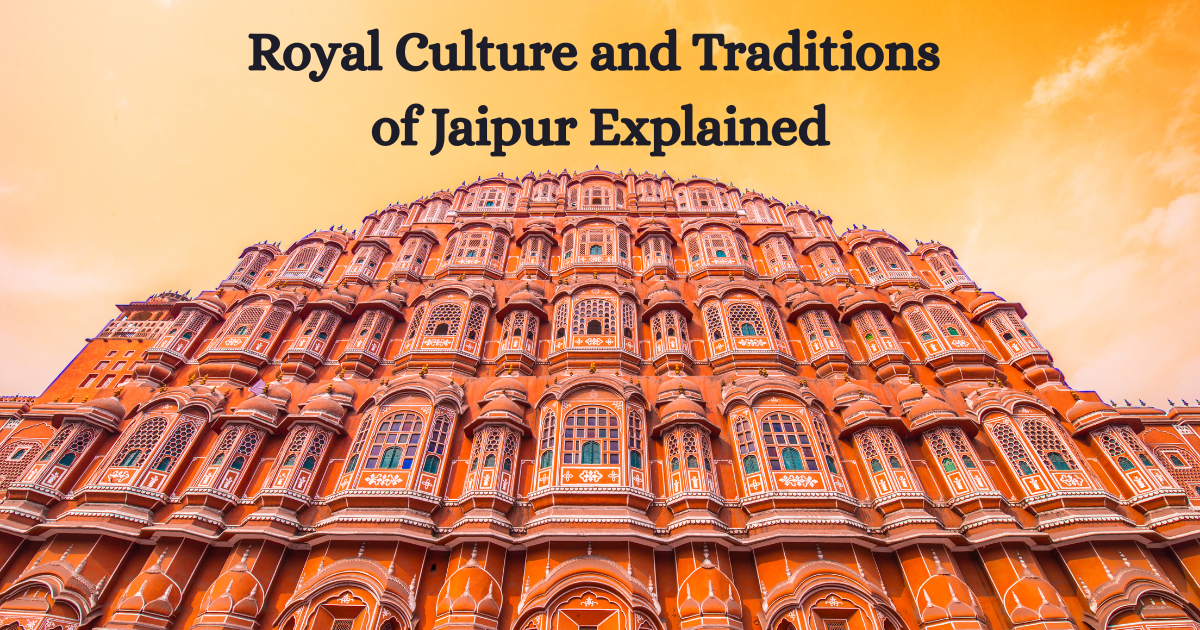
The architectural style of Jaipur’s major monuments — Amber Fort, City Palace, Hawa Mahal, Jantar Mantar — represents the most sophisticated expression of Rajput-Mughal architectural synthesis. Amber Fort combines massive Rajput military engineering with the delicate decorative vocabulary of Mughal courtly architecture in its interior spaces — the Sheesh Mahal (Hall of Mirrors), the Ganesh Pol gateway, and the Jai Mandir are among the most beautiful interior spaces in India. The Hawa Mahal, with its 953 latticed windows designed to allow royal women to observe street life without being seen, is one of the most architecturally original buildings in the world.
Atithi Devo Bhava — The Culture of Hospitality
Perhaps the most profound cultural tradition of Jaipur — and of Rajasthan as a whole — is its culture of hospitality. The Sanskrit phrase Atithi Devo Bhava — “the guest is God” — is not just a motto in Rajasthan; it is a deeply lived value that has been central to Rajput culture for centuries. The tradition of mehmaan-nawazi (guest welcoming) in Jaipur means that visitors are treated with a generosity and warmth that can feel genuinely overwhelming to those encountering it for the first time.
This culture of hospitality was formally expressed in the royal court through the tradition of offering guests sherbet, paan (betel leaf), and gifts upon arrival. At a domestic level it meant that no guest — whether a family member, a neighbour, or a stranger who appeared at the door — would ever leave a Rajasthani home without being fed. Today, this hospitality culture is visible in the warmth of Jaipur’s guesthouse owners, the generosity of street food vendors who add extra portions without being asked, and the genuine friendliness of locals who stop to help lost tourists without any expectation of reward.
The Jaipur Literature Festival
No discussion of Jaipur’s cultural life would be complete without mentioning the Jaipur Literature Festival — the world’s largest free literary event, held every January at the Diggi Palace hotel. The festival brings together thousands of writers, thinkers, historians, journalists, poets, and Nobel laureates from across the world for five days of talks, debates, readings, and cultural performances. It draws over 250,000 visitors each year and has featured virtually every major literary figure of the contemporary world since its founding in 2006.
The festival is free to attend and offers an extraordinary combination of intellectual engagement and cultural immersion — alongside the literary sessions, there are folk music performances, Rajasthani food stalls, handicraft exhibitions, and the constant presence of Jaipur’s own heritage as a backdrop. For visitors who happen to be in Jaipur in January, the Literature Festival is an unmissable experience that beautifully embodies the city’s unique combination of ancient tradition and cosmopolitan openness.
How to Experience Jaipur’s Royal Culture as a Visitor
Jaipur’s royal culture is not confined to museums and ticketed attractions — it is woven into the daily life of the city and accessible to any visitor who is willing to slow down, look carefully, and engage with genuine curiosity. Here are the best ways to experience the living culture of Jaipur during your visit.
Visit City Palace and Its Museum
The City Palace museum is the single best introduction to Jaipur’s royal history and culture. The collection of royal costumes, weapons, paintings, and artifacts is extraordinary and the architecture of the complex itself — with its layered courtyards, carved gateways, and decorated halls — tells the story of Jaipur’s royal heritage better than any book. The museum has excellent information panels and audio guides available that provide rich context for the exhibits.
Attend a Cultural Evening at a Heritage Venue
Many heritage hotels and cultural venues in Jaipur offer evening programmes featuring folk music, Ghoomar dance, Kalbelia dance, and Kathputli puppetry. These performances are typically accompanied by dinner or tea and take place in atmospheric courtyard settings. Chokhi Dhani on Tonk Road offers the most comprehensive version of this experience — an entire traditional village where cultural performances, folk arts, and authentic Rajasthani food come together in a single immersive evening.
Take a Heritage Walk Through the Old City
The old walled city of Jaipur is a UNESCO World Heritage Site and walking through its lanes is one of the most rewarding cultural experiences available to visitors. Several organizations and heritage hotels offer guided heritage walks that take you through the history, architecture, and living culture of the old city — including visits to neighbourhood temples, traditional craft workshops, and the private courtyards of historic havelis that are invisible from the street. A good guided walk will reveal layers of the city that independent exploration will simply miss.
Align Your Visit with a Festival
If you can time your visit to Jaipur to coincide with one of the city’s major festivals — Teej in July/August, Gangaur in March/April, the Kite Festival in January, or Diwali in October/November — your experience of the city’s culture will be transformed. Festivals are when Jaipur’s royal traditions come fully alive and when the distinction between spectator and participant essentially dissolves in the colour, music, and shared joy of celebration.
Final Thoughts
Jaipur is a city that rewards curiosity, rewards patience, and rewards the kind of deep, slow attention that truly remarkable places always demand. Its royal culture is not a performance laid on for tourists — it is a living, breathing civilization that has been growing, adapting, and deepening for three centuries. The Maharajas who built this city created not just magnificent buildings but a complete way of life — an aesthetic, a moral code, a relationship with art and beauty — that their descendants and the people of Jaipur continue to inhabit and honour today.
Whether you come to Jaipur for its forts, its food, its festivals, or its famous bazaars, you will leave with something deeper — a sense of having touched a culture that is simultaneously ancient and alive, royal and intimate, grand and deeply human. That is the true gift of Jaipur.