
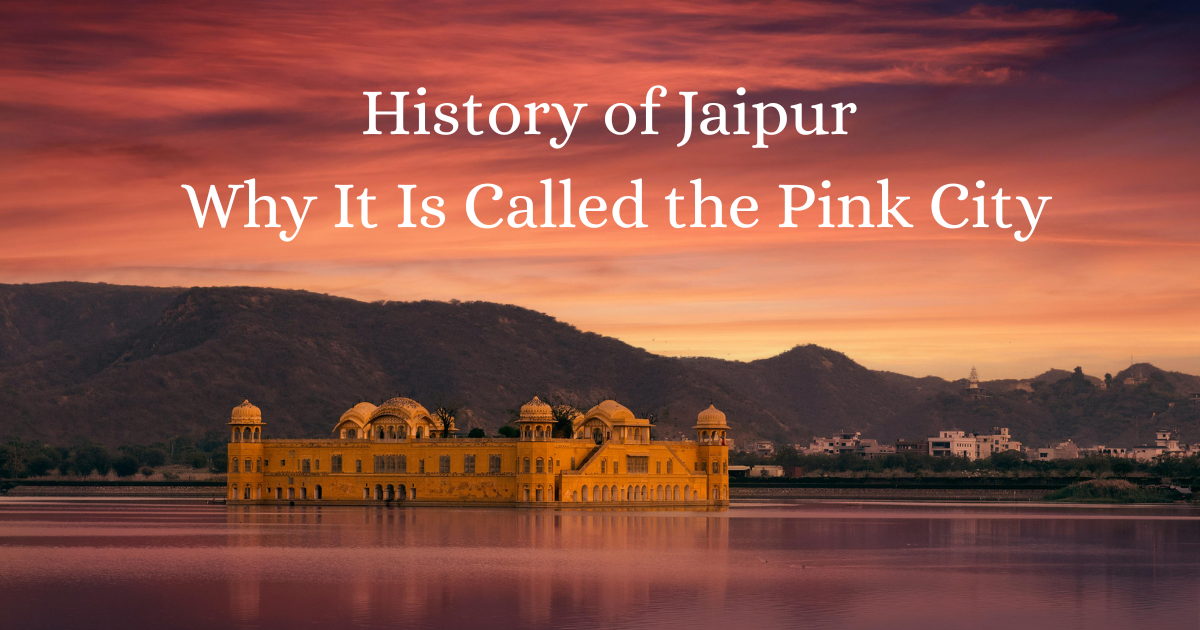
Every city has a story. But few cities in the world have a story as vivid, as dramatic, and as deeply layered as Jaipur. From its founding as a visionary planned city in the early 18th century to its distinctive pink colour that has defined its skyline for nearly 150 years, Jaipur’s history is a fascinating tapestry of royal ambition, scientific brilliance, political intrigue, cultural flowering, and extraordinary architectural achievement. Understanding the history of Jaipur is not just an academic exercise — it is the key to truly seeing and appreciating the city as it stands today.
This article takes you through the complete history of Jaipur — from the ancient Kachwaha Rajput origins at Amber to the founding of the planned city in 1727, from the era of British colonial influence to the city’s transformation into the capital of modern Rajasthan, and of course, the full story behind why this magnificent city is painted pink.
Table of Contents
- Before Jaipur: The Kachwaha Rajputs and Amber
- Maharaja Sawai Jai Singh II — The Visionary Founder
- How Jaipur Was Planned and Built
- Vidyadhar Bhattacharya — The Architect of the Pink City
- The Grid, the Walls, and the Nine Blocks
- Jai Singh’s Obsession with Astronomy — The Jantar Mantar
- After Jai Singh II — Jaipur Under Later Maharajas
- Why Is Jaipur Called the Pink City?
- Jaipur in the British Era
- After Independence — From Princely State to State Capital
- The Great Monuments of Jaipur and Their Stories
- UNESCO World Heritage Status
- Jaipur Today
Before Jaipur: The Kachwaha Rajputs and Amber
The story of Jaipur does not begin in 1727 — it begins several centuries earlier in the rocky hills of the Aravalli range, about 11 kilometres from where the city stands today. The Kachwaha clan of Rajputs — who claimed descent from Kush, one of the sons of Lord Rama of the Hindu epic Ramayana — established themselves in this region around the 12th century. They made Amber (also spelled Amer) their capital, building a series of increasingly magnificent fortresses and palaces on the rugged hilltop that still dominates the landscape north of modern Jaipur.
The Kachwaha rulers of Amber were distinguished among Rajput clans for their pragmatic political intelligence. Unlike many other Rajput rulers who fought prolonged, ultimately futile wars against the expanding Mughal Empire, the Kachwahas entered into a strategic alliance with the Mughals as early as the reign of Emperor Akbar in the 16th century. Maharaja Bharmal of Amber gave his daughter in marriage to Akbar in 1562, cementing an alliance that would prove enormously beneficial to the Kachwaha kingdom for generations. His grandson Maharaja Man Singh I rose to become one of Akbar’s most trusted generals and was appointed governor of Bengal, Kabul, and other important provinces.
This alliance with the Mughals brought enormous wealth, cultural influence, and political power to the Kachwaha court. Amber became one of the most prosperous and culturally sophisticated kingdoms in Rajputana. The magnificent Amber Fort — with its blend of Rajput military architecture and Mughal decorative sensibility — stands as the supreme physical expression of this cultural synthesis. But by the early 18th century, Amber was beginning to show its limitations. The population was growing rapidly, the rocky hillside offered no room for expansion, and most critically, water was becoming increasingly scarce in the arid hills.
Maharaja Sawai Jai Singh II — The Visionary Founder
Sawai Jai Singh II was born on 3 November 1688 and became the ruler of Amber at the age of just eleven, following the untimely death of his father Mirza Raja Bishan Singh on 31 December 1699. Despite his youth, Jai Singh quickly demonstrated qualities that would define his reign — extraordinary intelligence, fierce ambition, and a passionate curiosity about the world that extended far beyond the typical interests of a Rajput warrior-king.
Jai Singh learnt Hindi, Sanskrit, and Persian and developed a keen interest in mathematics and astronomy at an early age. He was not merely a military commander or a political ruler — he was a genuine polymath who corresponded with European scientists, collected astronomical manuscripts from across the known world, and spent much of his life trying to reconcile the astronomical traditions of India, Persia, Arabia, and Europe into a unified and accurate system of celestial measurement.
The title of “Sawai” — meaning one and a quarter times superior to his contemporaries — was given to him by Mughal Emperor Aurangzeb before the siege of Khelna Fort in Deccan. This title, which Jai Singh was immensely proud of, was retained by all subsequent rulers of Jaipur and became part of the official royal title of the state. It speaks to the extraordinary impression that even as a young man he made on the most powerful ruler of his time.
As his reign progressed and the limitations of Amber became increasingly apparent, Jai Singh II wanted to build the new capital on the plains of the region, driven by practical foresight to accommodate a growing population using up water supplies on the rocky hills of Amber. But unlike most rulers who simply built a new palace or expanded an existing settlement, Jai Singh II conceived something far more ambitious: he would build an entirely new city from scratch — the first properly planned city in the history of India.
How Jaipur Was Planned and Built
Jaipur was founded on November 18, 1727, planned as a meticulously designed city blending ancient traditions with contemporary urban design. Before establishing Jaipur, Jai Singh II governed from Amber, situated a mere 11 kilometres away. The decision to build a new city rather than expand Amber was a bold and visionary one — it required enormous resources, meticulous planning, and the political will to relocate an entire royal court and supporting population.
Construction of the new capital began as early as 1725, although it was only in 1727 that the foundation stone was ceremonially laid. By 1733, Jaipur officially replaced Amber as the capital of the Kachwahas. The construction was remarkably swift by the standards of the era — it took about four years to build the main palaces and roads.
Jai Singh II did not plan the city on instinct alone. He consulted several architects while planning the layout of Jaipur and established the city based on the principles of Vastu Shastra and Shilpa Shastra, under the architectural guidance of Vidyadhar Bhattacharya. He also studied the layouts of European planned cities and consulted ancient Indian architectural texts, astronomical tables from Arabia and Persia, and the works of Greek scholars including Ptolemy and Euclid. The result was a city that was simultaneously rooted in ancient Indian spatial wisdom and informed by the best urban planning knowledge of the 18th century world.
Vidyadhar Bhattacharya — The Architect of the Pink City
Behind every great city is a great architect, and behind Jaipur stands one of the most remarkable and yet under-celebrated figures in the history of Indian architecture — Vidyadhar Bhattacharya. Jai Singh II approached Vidyadhar Bhattacharya, who was an auditor in Amber State at the time, and shared his dream of establishing a city that would provide safety to the general population and serve as an architectural example to the world.
Vidyadhar was not a professional architect in the modern sense — he was a scholar, a mathematician, and an administrator. But he had deep knowledge of the ancient Sanskrit texts on city planning and architecture, particularly the Shilpa Shastra and Vastu Shastra. To assist with this huge undertaking, Vidyadhar consulted ancient Indian texts concerning astronomy and classical texts from the West including those by Ptolemy and Euclid. This resulted in Jaipur becoming India’s first planned city, based on a grid plan with wide roads and all the buildings aligning.
What Vidyadhar achieved in Jaipur was genuinely extraordinary. He took a flat, open plain and transformed it into one of the most sophisticated and logically organized urban environments of the 18th century world. The scale, the regularity, and the internal coherence of the Jaipur he designed were unprecedented in Indian urban planning and remain impressive even by modern standards. Despite his monumental contribution, Vidyadhar received relatively little official recognition during his lifetime — but his creation speaks for itself and will stand for centuries to come.
The Grid, the Walls, and the Nine Blocks
The layout of Jaipur as designed by Vidyadhar Bhattacharya is one of the most distinctive and thoughtfully organized urban plans in the history of Indian cities. The city was divided into nine blocks, two of which contained the state buildings and palaces, with the remaining seven allotted to the public. Huge ramparts were built, pierced by seven fortified gates. The city is unusual among pre-modern Indian cities in the regularity of its streets, and the division of the city into six sectors by broad streets 34 metres wide.
The nine blocks — called chowkris in local terminology — were each assigned to different communities and functions. Merchants, craftsmen, and artisans of different trades were settled in specific areas of the city, creating a natural specialization that is still visible today in the bazaar streets of the old walled city. Johari Bazaar became the jewellers’ market, Tripolia Bazaar the metalworkers’ street, Kishan Pol Bazaar the merchants’ lane — a functional organization that has persisted for nearly three centuries.
The main streets of Jaipur run perfectly north-south and east-west, creating a grid of remarkable regularity. The primary avenues are 34 metres wide — extraordinarily broad by the standards of any 18th century city anywhere in the world. These wide streets were not merely aesthetic choices — they served practical functions including facilitating the movement of troops and elephants, allowing adequate air circulation in the hot Rajasthani climate, and ensuring that every part of the city received adequate sunlight.
The city was enclosed by massive walls with seven fortified gates — each gate aligned precisely with one of the cardinal or intercardinal directions — and the entire walled city was further protected by the hills and forts that surrounded it on three sides. Merchants from all over India settled down in the relative safety of this rich city, protected by thick walls and a garrison of 17,000 soldiers including adequate artillery. Jaipur rapidly became one of the most prosperous trading cities in northern India.
Jai Singh’s Obsession with Astronomy — The Jantar Mantar
Perhaps the most remarkable expression of Maharaja Sawai Jai Singh II’s extraordinary intellect is the Jantar Mantar — the magnificent astronomical observatory he built in the heart of his new city. Maharaja Sawai Jai Singh II also received Imperial backing for building his astronomy observatories at Delhi, Jaipur, Varanasi, Ujjain, and Mathura. Of all these observatories, the one at Jaipur — built in 1734 — is the largest, the best preserved, and the most architecturally spectacular.
The Jantar Mantar is not an observatory in the conventional sense of a building containing telescopes. Instead, it houses a collection of scientific instruments used to measure the positions and movements of stars and planets. Jantar Mantar means “instruments for measuring the harmony of the heavens”. The instruments are of masonry construction and their large size enables them to be extremely accurate.
The instruments at Jantar Mantar were designed and built by Jai Singh himself based on his own astronomical research. He had detected inconsistencies in earlier astronomy tables that had occurred due to changes in the positions of the heavenly bodies and designed some of the instruments himself, including the Ram Yantra, Samrat Yantra, and Jai Prakash Yantra. The Vrihat Samrat Yantra — the Great Supreme Instrument — is the world’s largest sundial, capable of measuring time to within two seconds of accuracy. This level of precision, achieved using only masonry construction in the early 18th century, is a testament to the extraordinary scientific sophistication of Jai Singh’s approach.
Jai Singh was a scholar with a miscellaneous collection of astronomical manuscripts and tables from Arabia and Europe, including the Englishman John Flamsteed’s works, the Portuguese astronomer Pere de la Hire’s tables, the Turkish royal astronomer Ulugh Beg’s tables, and the Greek Ptolemy’s Almagest. He synthesized all these traditions into a unified observational practice that was, in several respects, ahead of contemporary European astronomy. Today, the Jantar Mantar is a UNESCO World Heritage Site and one of the most visited attractions in Jaipur.
After Jai Singh II — Jaipur Under Later Maharajas
Maharaja Sawai Jai Singh II died on 21 September 1743 after a reign of over four decades that had transformed a rocky hilltop capital into one of the most sophisticated and prosperous cities in India. His death triggered a period of political instability and succession struggles that temporarily weakened the kingdom. His sons fought over the throne and the kingdom was briefly threatened by Maratha incursions and internal divisions.
However, Jaipur’s fundamental strength — its extraordinary planning, its commercial prosperity, its rich artisan traditions, and its strategic location — ensured its continued growth even through these turbulent years. Under subsequent Maharajas the city continued to develop and flourish. The reign of Maharaja Sawai Pratap Singh (1778–1803) produced one of Jaipur’s most iconic monuments: the Hawa Mahal, built in 1799, designed by architect Lal Chand Ustad to resemble the crown worn by Krishna, one of Hinduism’s major deities. The five-story palace has 953 jharokhas — overhanging enclosed balconies with intricate lattice work — which overlook the bazaar and street. When the palace was built, royal women lived in seclusion and viewed the outside world through these jharokha windows.
The reign of Maharaja Sawai Ram Singh II (1835–1880) was another period of remarkable progress and reform for Jaipur. He was a modern progressive ruler who implemented many more reforms than most of the princes of the time, including reorganizing Jaipur into new administrative zones, introducing judicial and social reforms, and abolishing slavery and outlawing infanticide. During his minority, sati was legally banned in 1846. Ram Singh II also emphasized infrastructure and education. The city’s wide boulevards were paved and lit with gas. The city had several hospitals. Its chief industries were in metals and marble, fostered by a school of art founded in 1868. The city also had three colleges, including a Sanskrit college founded in 1865 and a girls’ school initiated in 1867. And it was during his reign that one of Jaipur’s most famous and enduring traditions was born.
Why Is Jaipur Called the Pink City?
This is the question that every visitor to Jaipur asks — and the answer is a fascinating story that combines royal hospitality, imperial politics, and the cultural symbolism of colour in Rajasthani tradition.
During the rule of Sawai Ram Singh II, the city was painted pink to welcome Albert Edward, Prince of Wales, in 1876. The Prince of Wales — who would later reign as King Edward VII — was making an official tour of British India, and Jaipur was one of the stops on his itinerary. Maharaja Ram Singh II was determined to make the royal visit a spectacular occasion that would demonstrate Jaipur’s wealth, sophistication, and the warmth of its people.
At the time, pink was the symbolic colour of hospitality in Rajput culture. As the people of Jaipur are known for their incredible hospitality, Maharaja Sawai Ram Singh had the whole city painted pink to welcome the royals. It is said that Prince Albert nicknamed Jaipur the Pink City and the name stuck. The Maharaja also commissioned the construction of a grand concert hall named Albert Hall in honour of the Prince — the magnificent Indo-Saracenic building that today houses the oldest museum in Rajasthan.
In 1877, the Maharaja Ram Singh took the pink obsession one step further. After the Queen of Jaipur declared herself a fan of the pink, he passed a law stating that any future buildings in the city must be painted the same colour. This law — which remains in force today with minor modifications — is the reason the old walled city of Jaipur has maintained its remarkable visual coherence and its signature pink identity for nearly 150 years. Property owners within the walled city are legally required to maintain the pink colour on their exterior walls, and the municipal corporation enforces this requirement periodically by repainting public buildings and heritage structures.
The specific shade of pink used in Jaipur is a warm, earthy terracotta tone — not the bright fuchsia of a party decoration but a deep, sandstone-influenced hue that shifts subtly through the day as the light changes. In the golden light of early morning it glows almost orange; in the harsh midday sun it appears a dusty rose; in the soft amber of late afternoon it deepens into a rich, warm red-pink that is genuinely one of the most beautiful urban colour experiences in the world.
Jaipur in the British Era
Jaipur signed, in 1818, a treaty after the Third Anglo-Maratha War with the English East India Company, becoming a princely state under British suzerainty. This marked a new chapter in the history of Jaipur. Under this arrangement, the Maharajas of Jaipur retained internal sovereignty over their kingdom but acknowledged British supremacy in external affairs and defence. The arrangement was, in practice, a significant curtailment of Jaipur’s independence — but it also provided a period of relative political stability that allowed the city to focus on internal development and prosperity.
The British era brought significant changes to Jaipur. The railway arrived in 1875 — Jaipur Junction railway station was built in 1875 and is situated at the centre of Rajasthan, serving almost 35,000 passengers daily. The railway transformed Jaipur’s economy by dramatically improving the city’s connections to major markets and ports, accelerating the growth of its gem, jewellery, and textile trades. The city’s population grew rapidly — by 1900 it had a population of 160,000.
The later British period also saw the reign of Maharaja Sawai Man Singh II (1922–1970), perhaps the most internationally celebrated of all Jaipur’s Maharajas. Man Singh II was a distinguished polo player of international renown, a respected statesman, and a cultural ambassador for Jaipur and Rajasthan on the world stage. He played polo in England, was an officer in the British Indian Army, and later served as the first Rajpramukh (governor) of Rajasthan and subsequently as India’s ambassador to Spain. His consort, Maharani Gayatri Devi, was one of the most glamorous and celebrated figures of 20th century India — a political leader, a beauty icon, and a passionate advocate for women’s education in Rajasthan.
After Independence — From Princely State to State Capital
When India gained independence on 15 August 1947, the country’s hundreds of princely states were faced with a choice: accede to the new Indian Union or remain independent. The process of integrating Rajasthan’s many princely states into a unified state was complex and took place in stages over several years. After India’s independence in 1947, Jaipur was integrated into the Indian Union and in 1949 was made the capital of the newly created state of Rajasthan — marking a significant moment in the history of Jaipur as it transitioned from princely rule to democratic governance.
The creation of Rajasthan as a unified state was an enormous administrative achievement. The new state brought together 22 princely states and three chieftainships into a single political entity, with Jaipur — by far the largest and most prosperous of the former princely states — as its natural capital. Since 1949, Jaipur has grown dramatically from a historic walled city into a sprawling modern metropolis that is today one of the fastest-growing cities in India.
The Great Monuments of Jaipur and Their Stories
The history of Jaipur is written most vividly in its monuments — and the city has some of the most magnificent heritage buildings in all of India. Here is a brief historical overview of the most important.
Amber Fort
About 7 miles outside of Jaipur, Amer Fort was built by Raja Man Singh to protect Amer, Rajasthan’s capital. In following years, other kings added to the fort, creating a structure that reflects both Muslim and Hindu architecture. Made of sandstone and marble, the fort has four sections, each with its own entrance and courtyard. The main entrance is known as the Suraj Pol (Sun Gate). The Sheesh Mahal inside the fort — its walls and ceiling covered in thousands of tiny mirror pieces — was built so the Maharani could stargaze, since the queen was not permitted to sleep outdoors. A single candle lit inside creates the illusion of a star-filled sky.
City Palace
The City Palace complex in the heart of the old walled city was begun by Maharaja Sawai Jai Singh II and expanded by his successors over the following centuries. It serves simultaneously as a royal residence (the innermost Chandra Mahal is still home to the current Maharaja), a museum of extraordinary royal artifacts, and one of the finest examples of Rajput-Mughal architectural synthesis in India. The palace’s seven-storey Chandra Mahal, its decorative gateways, and its magnificent courtyards are among the most beautiful spaces in Jaipur.
Hawa Mahal
The Hawa Mahal is one of Jaipur’s most visited attractions, built in 1799 by Maharaja Sawai Pratap Singh. The five-story palace was designed by architect Lal Chand Ustad to resemble the crown worn by Krishna. There are no stairs inside the palace, only a series of ramps. Its 953 latticed windows allow cool breezes to circulate through the building at all times — making it an early example of passive climate control in Indian architecture — and allowed the royal women of the court to observe street life and festival processions without being seen themselves.
Nahargarh Fort
Nahargarh Fort crowns the hill in the northwest corner of the old city. Built by Maharaja Sawai Jai Singh II in 1734 as part of Jaipur’s defence system, Nahargarh — meaning “abode of tigers” — offers the most spectacular panoramic views of the entire city. It was later extended by Maharaja Sawai Ram Singh II and Maharaja Sawai Madho Singh II and includes a remarkable series of interconnected royal suites built for the Maharaja’s nine queens — each suite identical in layout so that no queen could feel favoured or slighted.
UNESCO World Heritage Status
In July 2019, the walled city of Jaipur was inscribed as a UNESCO World Heritage Site — a recognition of its outstanding universal value as an exceptionally well-planned historic city. The UNESCO citation highlighted Jaipur’s innovative urban planning based on the ancient Shilpa Shastra, its remarkable architectural heritage representing a fusion of Hindu, Mughal, and Western influences, and its extraordinary continuity as a living, functional urban centre that has maintained its historic character for nearly three centuries.
The UNESCO inscription was a matter of enormous pride for Jaipur and Rajasthan — and it brought international attention to the urgency of preserving the old walled city’s architectural heritage in the face of rapid urban growth and development pressures. The designation also placed a legal and institutional obligation on the municipal authorities to ensure that any changes to buildings and infrastructure within the walled city are carefully managed to protect the historic character of this irreplaceable urban landscape.
Jaipur Today
Modern Jaipur is a city of over 3 million people — the 11th largest city in India — and one of the country’s most rapidly growing urban centres. It is the administrative capital of Rajasthan, a major hub for the gems and jewellery trade, a significant centre for information technology and business process outsourcing, and one of the most visited tourist destinations in Asia.
The city has expanded dramatically beyond the original walled city, with modern residential suburbs, commercial districts, IT parks, universities, hospitals, and a functioning metro system now extending across a much larger urban area. The contrast between the historic pink walls of the old city and the glass facades of the new commercial districts makes for a striking and sometimes dissonant urban landscape — but it also reflects the fundamental dynamism of a city that has always been in motion, always growing, always reinventing itself while holding fast to the extraordinary heritage at its core.
What has not changed — and what no amount of urban growth can change — is the quality that has always set Jaipur apart from other Indian cities: the sense of a place that was imagined and built with intention, with vision, and with a genuine belief in beauty as a civic value. Maharaja Sawai Jai Singh II set out in 1727 to build not just a capital but a great city. Nearly three centuries later, walking through the pink lanes of the old walled city at dawn, it is impossible not to feel that he succeeded beyond any reasonable expectation.
Final Thoughts
The history of Jaipur is a story that rewards curiosity. Every building, every bazaar lane, every gate and fort and palace has a chapter to tell — of the kings and architects who built them, of the artists and craftsmen who decorated them, of the merchants and soldiers who animated them, and of the countless ordinary people who have lived and worked and loved within their walls for nearly 300 years. The pink colour that gives the city its famous nickname is just one thread in this rich tapestry — a beautiful and visible one, but only one.
The next time you walk through the old walled city of Jaipur and see those warm pink walls glowing in the afternoon light, you are looking at something truly rare: a city that was imagined by a visionary king, built by a brilliant architect, painted in welcome for a royal guest, and preserved by law and by love for generation after generation. That is the history of the Pink City — and it is still being written today.