
If there is one Indian city that can genuinely claim the title of shopping paradise, it is Jaipur. The Pink City is not just a destination for history and heritage — it is one of the great craft capitals of the world, home to generations of master artisans whose skills in jewellery, textiles, pottery, stonework, and leather have been passed down through centuries of royal patronage and living tradition. Every bazaar lane in the old walled city tells the story of a craft — the jewellers of Johari Bazaar, the textile printers of Sanganer, the lac bangle makers of Maniharon ka Rasta, the blue pottery studios of the old city lanes.
The challenge in Jaipur is not finding things to buy — it is deciding what not to buy. The sheer variety and quality of handicrafts, textiles, jewellery, and souvenirs available in Jaipur is genuinely overwhelming to first-time visitors. This complete shopping guide covers everything you need to know — the best things to buy, how much to pay, where to find the most authentic versions, how to spot quality, and how to bargain without getting ripped off. Whether you have a budget of ₹500 or ₹50,000, this guide will help you bring home the best of Jaipur.
Table of Contents
- Blue Pottery — Jaipur’s Most Iconic Craft
- Jewellery — Kundan, Meenakari and Gemstones
- Block-Printed Textiles and Fabrics
- Lehariya and Bandhani — The Tie-Dye Traditions
- Jootis and Mojris — Traditional Rajasthani Footwear
- Lac Bangles — The Signature Bangle of Jaipur
- Jaipuri Rajai — The Famous Quilts
- Kathputli Puppets — Rajasthani String Puppets
- Marble and Stone Crafts
- Miniature Paintings
- Brass and Metalwork
- Edible Souvenirs — Sweets and Spices
- Best Markets and Bazaars for Shopping in Jaipur
- How to Bargain in Jaipur
- What to Avoid and How to Spot Fakes
Blue Pottery — Jaipur’s Most Iconic Craft
If you ask any seasoned traveler what single item best represents Jaipur’s craft heritage, the answer is almost always the same: Blue Pottery. This extraordinary art form is one of the most distinctive and unusual crafts in the entire world — and it is uniquely associated with Jaipur. Unlike virtually every other form of pottery in existence, genuine Jaipur Blue Pottery is not made from clay. The base material is a carefully formulated mixture of quartz stone powder, powdered glass, Multani mitti, and borax. This unique composition is fired at low temperatures and produces the characteristic translucent, glossy surface and the brilliant blue and white colouring that makes genuine Jaipur Blue Pottery immediately recognisable.
The art form has its origins in Persian and Central Asian ceramic traditions brought to India via the Mughal court. Today it is a Geographical Indication product — legally recognised as originating specifically from Jaipur — and is made by a relatively small number of specialist workshops and studios in the city.
Blue Pottery products range enormously in size and price. Small items like tiles, coasters, and small bowls are available from ₹100 to ₹500 — excellent lightweight souvenirs. Medium pieces like vases and decorative wall plates cost approximately ₹300 to ₹1,500. Larger decorative pieces cost ₹2,000 to ₹8,000 or more. To identify genuine handmade pieces: look for slight irregularities in the painted design, a soft uneven glaze quality, and a slight translucency when held up to light. For authentic pieces, visit Kripal Kumbh workshop or the government-operated Rajasthali emporium on MI Road.
Jewellery — Kundan, Meenakari, Gemstones and Silver
Jaipur is the jewellery capital of India and one of the world’s most important centres for gemstone cutting, jewellery manufacturing, and precious metal work. The city has been a centre of jewellery-making for over three centuries and today hosts thousands of jewellery workshops, wholesale dealers, and gemstone cutting studios within the old walled city.
Kundan Jewellery
Kundan is the most prestigious jewellery tradition of Jaipur. The technique involves setting uncut gemstones into 24-carat gold by carefully moulding the gold directly around each stone — no heat or chemical processes are used. The result is jewellery of remarkable delicacy in which the stones appear to float within their golden settings. More affordable Kundan pieces using semi-precious stones start from as little as ₹500 to ₹2,000 for earrings. The best workshops are in the lanes of Gopalji ka Rasta and Haldion ka Rasta off Johari Bazaar.
Meenakari Jewellery
Meenakari is the art of enamelling metal surfaces with brilliant colours — red, green, blue, and white — to create intricate decorative patterns. The technique was brought to Jaipur from Lahore by Maharaja Man Singh I in the 16th century. The most special form is the reversible piece — Kundan gemstones on one side and Meenakari enamel work on the other. Meenakari earrings start from ₹200 to ₹800 for silver pieces. Look also for Thewa jewellery — a unique Rajasthani technique in which intricately worked sheet gold is embossed in molten glass to create jewellery of extraordinary detail.
Gemstones
Jaipur is one of the world’s major gemstone-cutting and trading hubs, processing emeralds, rubies, sapphires, amethysts, garnets, and tourmalines. If knowledgeable about gemstones, buying loose stones here can be excellent value. However, this area is where inexperienced buyers are most vulnerable. Only buy from reputable, established dealers — ideally recommended by your hotel — and insist on a certificate of authenticity for significant purchases.
Silver Jewellery
Jaipur also has an outstanding tradition of silver jewellery — heavy, ornate pieces in traditional Rajasthani designs as well as modern interpretations. Silver jewellery is priced by weight plus making charges and represents excellent value. The tribal silver jewellery designs — large earrings, chunky necklaces, and broad bangles in bold geometric patterns — are among the most distinctive items for fashion-conscious shoppers.
Block-Printed Textiles and Fabrics
Jaipur’s most universally beloved craft — and the one that fills more suitcases than any other — is its extraordinary tradition of hand block-printed textiles. The city and its surrounding villages, particularly Sanganer and Bagru, are the epicentres of a centuries-old tradition of printing cotton and silk fabrics by hand using intricately carved wooden blocks and natural dyes.
The Sanganer style features fine, delicate floral and geometric patterns printed in multiple colours on white or cream cotton — inspired by Mughal design vocabulary including paisley, lotus, and stylised flower motifs. Bagru printing uses a more earthy palette — indigo blue, brick red, mustard, and black on natural off-white fabric — with bolder, more graphic folk patterns.
Block-printed textiles are available as dress fabric, kurtas, sarees, dupattas, stoles, bedspreads, cushion covers, table runners, tote bags, and more. A good quality block-printed cotton kurta costs ₹300 to ₹800. A beautiful block-printed bedspread costs ₹800 to ₹2,500. Fabric starts from ₹150 to ₹600 per metre. For the most authentic block-printed textiles, visit Anokhi on MI Road or the Sanganer village itself, about 16 km from the city centre, where you can buy directly from printers and watch the process firsthand.
Lehariya and Bandhani — The Tie-Dye Traditions
Alongside block printing, Jaipur is famous for two extraordinary tie-dye textile traditions uniquely Rajasthani in character. Lehariya — from the Rajasthani word for waves — is produced by rolling fabric diagonally and tying it at intervals before dyeing, producing characteristic diagonal wave patterns in vibrant colour combinations. Lehariya sarees, dupattas, and stoles in turquoise and orange, pink and green, or yellow and purple are among the most eye-catching items in any Jaipur market.
Bandhani is more complex — tiny portions of fabric are individually knotted using fingernails before dyeing, producing small dots in the finished design. A skilled bandhani artist can tie thousands of knots per day. Genuine hand-tied bandhani sarees cost ₹2,000 to ₹15,000 depending on fineness of work and fabric. Test authenticity by feeling one of the small dots — real bandhani knots have a slight three-dimensional texture that machine printing cannot replicate.
Jootis and Mojris — Traditional Rajasthani Footwear
No shopping list for Jaipur is complete without traditional Rajasthani jootis or mojris. These handcrafted leather shoes come in almost endless variety: pointed or round toes, flat or slight heels, fully embroidered uppers in gold and silver thread, mirror-work embellished versions, plain leather in rich colours, and elaborate ceremonial designs. Made entirely by hand with no machine involvement, a well-made pair lasts for years.
Nehru Bazaar is the most famous destination for jootis in Jaipur, with dozens of specialist shops. A decent quality pair costs ₹300 to ₹800. More elaborately embroidered versions range from ₹800 to ₹2,500. Always try before you buy — traditional jooti sizing can vary. Bapu Bazaar also has a good selection at competitive prices.
Lac Bangles — The Signature Bangle of Jaipur
Jaipur is one of India’s most important centres for lac bangle making — a craft dating back to the founding of the city itself. Lac is a natural resin shaped by skilled craftsmen into bangle forms and decorated with coloured enamels, mirror pieces, semi-precious stones, and sequins. The resulting bangles are lightweight, colourful, and extraordinarily beautiful — considered particularly auspicious for newly married women in Rajasthani tradition.
The dedicated lac bangle market is concentrated in Maniharon ka Rasta — the Street of Bangle Makers — in the old walled city. Walking through this lane is memorable: shops heaped floor to ceiling with bangles in every colour and design, craftsmen working at the front of their shops. Simple lac bangles cost ₹50 to ₹200 per set. Elaborate sets with mirror work and stone decoration cost ₹200 to ₹800. They are lightweight, affordable, and among the most authentically Rajasthani items from Jaipur.
Jaipuri Rajai — The Famous Quilts
The Jaipuri Rajai is one of the most beloved souvenirs from Jaipur — a lightweight cotton quilt filled with finely carded cotton wadding and covered in beautiful block-printed or plain-dyed cotton fabric. What distinguishes a genuine Jaipuri Rajai is its extraordinary lightness and warmth — the cotton filling is expertly carded to an airy consistency that traps warmth without weight, making it feel like sleeping under a cloud.
Rajais come in single, double, and king sizes with block-printed floral, plain, patchwork, or embroidered covers. A standard double-bed Rajai starts from ₹600 to ₹1,500. Higher quality versions cost ₹1,500 to ₹4,000. They take up considerable luggage space — carry a compression bag or ask about shipping options from the shop.
Kathputli Puppets — Rajasthani String Puppets
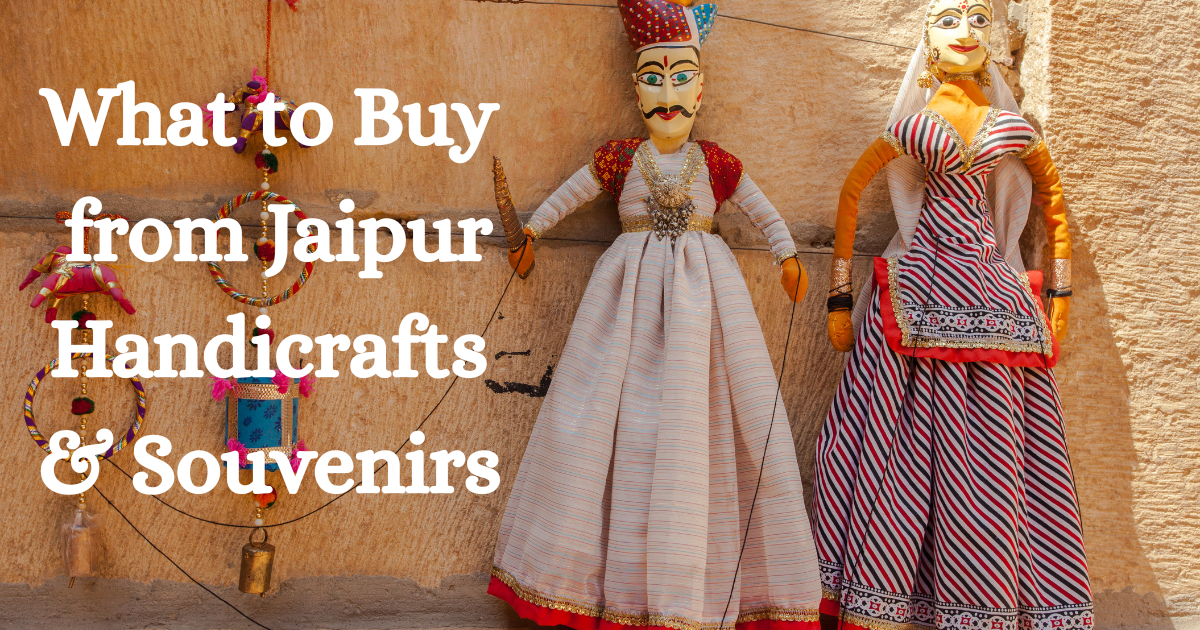
Kathputli — the traditional Rajasthani string puppet — is one of the most charming cultural souvenirs from Jaipur. These vividly dressed, hand-painted wooden marionettes are used by hereditary puppet artists from the Bhat community to tell stories of Rajput warriors and folk heroes. Each puppet features a hand-carved wooden head and hands, hand-sewn Rajasthani costume with miniature embroidery and mirror work, and strings attached to a wooden controller.
Small, simple puppets cost ₹100 to ₹300 and make excellent gifts for children. Larger, more finely crafted puppets with detailed costumes cost ₹400 to ₹1,500. The finest artisan-made puppets can cost more but are genuine pieces of folk art. They are lightweight, colourful, and completely unique to Rajasthan.
Marble and Stone Crafts
Rajasthan is home to some of India’s finest marble deposits and the tradition of marble carving and inlay work in Jaipur is extraordinary. The most famous technique is pietra dura or Parchin Kari — semi-precious stones including malachite, lapis lazuli, carnelian, and mother-of-pearl cut into precise shapes and inlaid into white marble surfaces in intricate floral and geometric patterns. This is the same technique used in the Taj Mahal and Amber Fort’s Sheesh Mahal.
Small marble items start from ₹200 to ₹800. Larger pieces like table tops and elephant figurines range from ₹1,000 to ₹20,000 or more. The main market for stone crafts is Chandpole Bazaar. When buying marble inlay work, look for clean, precise stone cutting with no visible gaps — gaps indicate lower quality work.
Miniature Paintings
The Jaipur school of miniature painting — developed under direct royal patronage from the 17th century — is one of the great traditions of Indian classical art. Genuine miniature paintings are produced on handmade paper or silk using fine brushes and natural pigments, depicting Hindu mythology, Rajput court life, royal portraits, and nature studies with characteristic rich jewel-toned colours and fine detail.
Genuine, high-quality miniature paintings are sold at galleries near Tripolia Bazaar and the lanes near City Palace. Prices start from ₹500 to ₹2,000 for smaller pieces and go much higher for larger works by established artists. The mass-produced printed copies sold at tourist stalls for ₹50 to ₹200 are printed reproductions — not miniature paintings — and should be clearly identified as such.
Brass and Metalwork
Jaipur has a distinguished tradition of metalwork in brass, copper, and silver producing objects of genuine beauty and utility. Brass items include decorative boxes, lamp stands, incense holders, thali sets, temple bells, figurines, and architectural elements. Tripolia Bazaar is the main market for traditional metalwork — slightly quieter and more authentic than Johari Bazaar, with shops where craftsmen will often describe the history and origin of each piece they sell.
Edible Souvenirs — Sweets and Spices
Some of the best souvenirs from Jaipur are edible. Ghewar — Jaipur’s most famous sweet — is available in vacuum-sealed packaging from quality sweet shops like LMB and Rawat Mishthan Bhandar and travels well for a few days. Churma Ladoo — sweet wheat and ghee balls — are available packaged at sweet shops. Rajasthani spice mixes including Laal Maas masala, regional garam masala, and packaged Rajasthani masalas are available at spice shops throughout the city and make lightweight, flavourful gifts. Packaged saffron, Misri rock sugar, and Rajasthani herbal teas are also popular edible souvenirs that are easy to carry home.
Best Markets and Bazaars for Shopping in Jaipur
Jaipur does not have one central market — different bazaars specialise in different crafts. Here is a guide to the most important shopping destinations.
Johari Bazaar
The oldest and most famous market in Jaipur — home to about 400 shops selling jewellery, gemstones, Kundan and Meenakari pieces, silver work, and precious stones. Also good for textiles and lac bangles. Open approximately 10 AM to 8 PM, closed Sundays for many shops. It is the oldest jewellery market in India and the heart of the Jaipur jewellery trade.
Bapu Bazaar
A one-stop destination for textiles, block-printed fabric, jootis, Rajais, lac bangles, Kathputli puppets, and home decor — all in one continuous stretch. Prices are competitive and variety is excellent. Ideal for covering multiple categories efficiently. Open approximately 10 AM to 9 PM daily.
Nehru Bazaar
Jaipur’s dedicated footwear market and best destination for traditional jootis and mojris. The concentration of specialist shops gives the widest selection in one place with competitive pricing.
Chandpole Bazaar
The market for marble and stone crafts, wooden items, and traditional handicrafts. Home to impressive marble sculptures, finely inlaid decorative pieces, and carved wooden items. Open approximately 10 AM to 7 PM.
Tripolia Bazaar
Slightly less touristy than Johari and Bapu Bazaar — a good choice for authentic traditional metalwork, paintings, and handicrafts. Shops have more of a genuine workshop character with craftsmen working and selling directly.
Rajasthali Government Emporium
For visitors uncomfortable bargaining or wanting assurance of fair prices for authentic crafts, the government-operated Rajasthali emporium on MI Road is an excellent option. Prices are fixed and non-negotiable but fair, and quality standards are maintained. Range covers Blue Pottery, textiles, jewellery, leather goods, and more.
How to Bargain in Jaipur
Bargaining is entirely normal in Jaipur’s bazaars — with the exception of government emporia and branded stores. The standard approach is to start your counter-offer at approximately 40 to 50 percent of the first quoted price. The shopkeeper will counter with a slightly reduced figure and you gradually meet in the middle — the final price is typically 50 to 70 percent of the opening quote. Walking away is completely acceptable and often results in the shopkeeper calling you back with a better offer.
Important note: prices quoted to tourists near major monuments are typically inflated significantly compared to prices in the main bazaars. Always compare across multiple shops before committing to a purchase. Also avoid buying from shops recommended by auto-rickshaw drivers — they receive commission of 20 to 40 percent which is added to your price.
What to Avoid and How to Spot Fakes
Jaipur’s thriving craft market also has a small but significant number of sellers offering poor quality or fake items to tourists. Here are the most common issues.
Synthetic Blue Pottery: Mass-produced ceramic items are widely sold as Blue Pottery. Test genuine pieces by examining the painted design for natural irregularities and checking for subtle translucency when held to light.
Machine-printed textiles sold as block-printed: Genuine block printing shows slight variations in pressure and slight bleeding at pattern edges. Machine-printed fabric has perfectly sharp, uniform edges throughout.
Glass bangles sold as lac: Genuine lac bangles have a slight warmth and flexibility when handled — they are not as cold and brittle as glass and slightly lighter for the same size.
Auto-driver shop commissions: Drivers who recommend specific shops are almost always working on a commission basis. The commission — typically 20 to 40 percent — is added to your price. Always find shops independently.
Final Thoughts
Shopping in Jaipur is one of the great pleasures of any visit to the Pink City — not just because the products are beautiful and affordable, but because the act of shopping here connects you directly to living craft traditions that have been practised in these very lanes for centuries. The lac bangle maker whose family has worked on Maniharon ka Rasta for six generations, the block printer in Sanganer whose father taught him to carve wooden blocks at the age of seven, the Meenakari enameller who can name every colour of vitreous enamel and its Persian origin — these are not just shopkeepers. They are the custodians of an extraordinary cultural inheritance.
Shop with curiosity, bargain with good humour, ask questions about how things are made, and bring home items that genuinely reflect the craftsmanship and culture of this magnificent city. Whatever you buy in Jaipur, make sure it earns its place in your suitcase — not just as a souvenir but as a story worth telling.